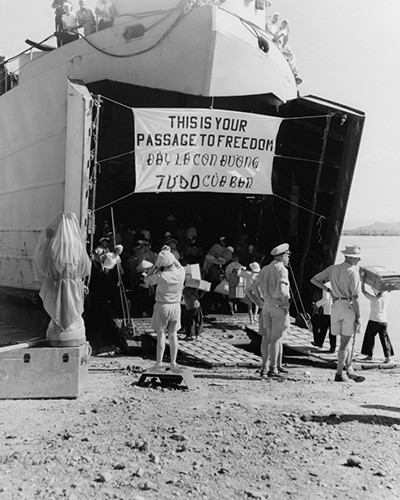
Before I, they. The four adults. Now two left, both in their early 80’s. Back in 1954, when the OSS and Colonial French bosses were in charge, my brother and sister, both late teens, were eager to emigrate to South of the new DMZ. Their trip was orchestrated for re-districting and motivated partly by land redistribution. 1 million made it South, via land and sea, with the help of the US Navy and French counterparts.
My brother later a medic Captain (in my father’s Army footsteps) often suppressed his creative talent: his pastime was for painting ships and ocean. Meanwhile, my sister formerly with Agri-Dev bank, still wants to pack up and move out of current nursing-home arrangement for her next resettlement – perhaps out of anxiety receded in long-term memory.
I, on the other hand, carried on our rambling tradition when Vietnam ended (for them, it was a deja vu). The adults took it more stoically – been there, done that. for me: first cut is the deepest – having to leave my friends, my familiar surroundings and territory behind. Luckily, my immigrant DNA were activated i.e. sniffed and navigated strange terrain: salad fork, steak fork and dessert fork (I settled for mash potatoes and peanut butter; easier that way).
For other kids, leaving for campus was a big deal.
For me, it’s an occasion for re-branding (even printing my personal “business card” with pronunciation, as one would find in the dictionary).
Dating? what’s that! Oh, you just want me to treat you on a night out, without any commitment? While both were “sexiled” (a Tom Wolfe’s term) by roommates, we conducted mate interviews before claiming back our dorm-room space.
So, I learned to cope, to adapt and to survive. Very much like my parents who after settling down South, one night on a creaky floorboard. Voila! An afterthought in the aftermath of North-South partition. Could have been worse – with 13th as opposed to 17th parallel demarcation.
Once the dust was settled this side of the Geneva accords, another agreement (consensual) between two adults gave birth to my restless genes.
Consequently, I always understood what’s it’s like to be an immigrant, a refugee, who picked up one’s life and fled in haste with no need for additional persuasion and propaganda (they had 300 days to ponder Passage to Freedom). It was less than 5 minutes when it’s my turn, before Operation Frequent Wind was activated ( its cue: White Christmas played on Armed Forces Radio near the Saigon Zoo).
The animals got left behind. Us human fled. On us, paper money from ATM and clothes on our back. A picture taken later during the vetting summer on Wake Island showed the entire cast and crew wearing the same outfit as first seen on fateful April 30, 1975.
In it, I stood still, in group picture, with a thousand-yard stare toward the camera, no Foster Grant sunglasses and no clues as to my immediate or long-term future.
Until today. This moment. I know I was cut out for the run. By instinct and by indirect experience. My immigrant DNA both helped and hindered me. It disrupts an otherwise normal and stable life. But then, there were forces at work, back then – 1954 and 1975 that triggered massive responses from us. We simply cannot sit still, and let our fate be decided. We were that “domino” which stood and fell, but in our own term. Today, it’s Taiwan. Yesterday, it’s Ukraine. On and on. Geo-political maneuvering, Kissinger style.
Then when I realize it comes in large part from within, I could only blame myself. For enjoying our lonely planet and the ships’ sirens. In the absence of “Passage to Freedom” and its 300-day cushion, I faced instant and tearful separation – a life interrupted.
Although ideology was not quite articulated, biology manifested itself without hesitation: The lust was deep down at cellular level.. Do I have any say, given more than 2/3 of me pre-programmed for life on the run. Once on Wake Island, half-way from either home, I over-heard Paul McCartney ‘s “Band on The Run” on the next barrack’s radio.
There’s a suitable soundtrack for a nomadic existence
 Thang Nguyen 555
Leave a comment