Thang Nguyen 555

Cultures on Collision Course

  • We are here to tell our stories. What’s your ending? Are you a late-bloomer, hence, saving the best for last? Or you believe that the best has already been behind i.e. apocalypse now.

    Not all is “horror, horror” as in the ending of Apocalypse Redux (the original version ends with ” we have met the enemy and the enemy is us” as the chopper came for the captain/assassin).

    I often wonder if Stephen Covey had known of his ending ( he died in a biking accident) or the owner of Segway Scooter (also died while riding his own invention). Other endings intrigue us still e.g. Amelia’s.

    Having a sense of an ending helps us

    • reduce our inflated ego
    • focus on the important, often buried among the urgent
    • appreciate life and its moments which pass unnoticed till the very end

    Start-up companies appreciate an audit and a pre-mortem analysis (what factors would contribute to our demise and how do we go about mitigating those risks). I would venture to carry this concept to health and family as well: what would likely be our “apocalypse”: high-blood pressure or cancer? Personality conflict or money issues?

    The ending is buried in the present. It shows signs and sends signals. We are the sender and receiver at the same time. We buy insurance and avoid risks. We long to tell our stories yet none of us know the inevitable ending to our stories. Some will fall and some will lie down. Last breath and last rite. To have an inkling of how the story ends is comforting and stress-reducing. It motivates us to do our best and to believe the best is yet ahead even beyond the grave. I for once tend to believe it.

    What’s your ending? and while at it, go hug a child and do smell the flowers. It’s what life has to offer, to the richest and poorest among us. Worry not about death and tomorrow. Solomon and all his wisdom couldn’t even be compared with the beauty of Spring-time Lillies. And there are plenty of those this time of the year, albeit not long-lasting. No wonder Emperors of the past had an assistant at his side, to remind him that “today you will die”. Keep at it since it’s the one prophecy that is the truest.
  • While sitting among Julie and friends – all 1st graders, I remembered my Ecole L’Aurore early years.

    Yes, I walked to school with Pierre. Pierre was a French bastard (100 years of French colonial rule – naturellement – produced a bunch to be expected).

    He would discuss Kennedy’s assassination. Then all of a sudden, he turned around and turned off the intersection control box. My oh my. Traffic was jammed up in one direction for miles (the police must have walked away for bathroom or coffee break).

    One night, I woke up to the sound of break-in. The thief was in the process of “fishing” out my mom’s purse (laid carelessly in the middle of our dinner table) with his long pole commonly seen in flea market with which the shop vendor can unhook a dangling dress on high.

    I was scared witless. Then all of a sudden, my shinning knight came to the rescue: my Dad emerged from the back of the house, throwing a knife which flew right by where my divan was (I slept alone on the first floor). Needless to say, the pole was tossed, and the thief ran away fast and furious.

    The same Dad who threw his knife when trespassed would roll down the steps when he missed his footing on one occasion. I thought with that stiff angle, he would be paralyzed for life. I screamed really loud “Daddddd” just to find him roll with the punch and emerged unscathed.

    Growing up in war-time refugee shanty town helped me appreciate the love and lust for life. People sing and dance, at times, uninvited. Knowing that death was nearby, everyone seemed to ignore it and go about the business of living. I heard more music in my times than the sound of artillery. Yet on that last month in Saigon, I could not ignore the sounds fleeing C-130’s that carried those privileged visa-holders to Guam, then, our sanctuary island.

    Temporary shelters and tents were erected. Nobody complained about the arrangement. Once again, we went about the business of living and hoping. And hope we did, until this day, and onto the next generation(s). I guess you can call us dreamers and doers. Both. Once in a while, while lunching with next-gen 1st-graders, I recall those early moments, some of which unpleasant, while others unclassifiable. Like Pierre and his prank, like the thief’s tool that ended up in our house. I am in possession of those memories for as long as I live free: breathe free and think free until death comes “like the thief in the night”.


  • Sounds from my youth

    Early on in life, I heard French spoken as French colonial influence was waning.

    Then of course our native language, Vietnamese.

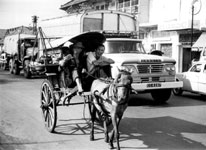
    By 1965, I began to hear helicopters, the humming of US Army jeeps fighting for right of way over horse carriages. Not to mention those Army’s C rations, like an opened cinnamon cake (those can- openers last forever – credits to the procurement department at the Pentagon).

    From there, the sound of violin (Chopin) from my brother and guitar from my neighbor (My Sweet Lord) all mashed up with increasingly more frequent sounds of one-string band as our neighbor returned from the front in a flag-draped casket. Can’t help but putting on “Reflections of my life” when I heard animal-like shrieks for three whole days.

    I took my first flight to Quy Nhon with my mom. We went to bury my niece who died pre-mature. That night was my first time exposed to the war front, with sounds of AK-47 raining down from the mountain, and M16 returning fires from the base, where my brother, a medic was pulling his tour of duty.

    Not all sounds from my youth were war-related – except for those rubber-sandals stumping on tin roof (urban VCs got chased by police who shot them up with Colt 45’s.) That year (Tet 68) I heard a mix of gun battles and firecrackers in downtown Saigon, where Colonel Loan executed a VC terrorist point-blank.

    I have seen a lot of running away from the ATM’s in my lifetime. Once during the evacuation in 1975, and the other, at Three-Miles-Island in 1979.

    People in panic, people in motion. Life? both stability and uncertainty. People take side, people change side and people just be there (like Peter Sellers in “Being There”). The sound of Buddhist monks protesting, of tear gas (1963) canisters and of combustible karosene that incinerated the “burning monk”. Then, unmistakably, the sound of the British Invasion (“Imagine all the people”). But one particular sound I haven’t heard of late, and that’s “I love you” in my native tongue. I grew up hearing a lot of “Je t’aime” from Charles Aznavour (Et pourtant, je t’aime que toi, Et pourtant) Sylvie Vartan (Tour les garçons and les filles), and French idols: Johnny Halliday and Alain Delon.

    Before I knew what had transpired, I was transported into a completely different “sound studio”, from man-eats-dog to dog-eats-dog world, where people call each other the “N” words, the “F” words and everything in between. It feels as if we had lost our way (Do you you know the way to San Jose).

    Civilization, globalization and its discontent. I wouldn’t know where to begin to compare today’s sounds against the backdrop of the sounds from my youth (the ping, the ring, the fire alarm, the Amber alert etc….) So I watched “A Star is Born” , both versions, 4 decades apart.

    And sure enough, I found what I was looking for: the sound in my head, and the sound outside of my head, co-exist but not co-locate ; on completely different tracks: like analog vs digital: each reflects an era and an ethos, an attitude and aspiration. Those sounds instantly transport us back to a time and a place, unmistakably. But the scariest of all, as we all know, is “the sound of silence”.

    Go to the Vietnam Memorial in Washington D.C. near the reflecting pool, where you can sure relate to the sounds from my youth, my friends’ – of the many who shouted “Hell No, We won’t go” (or those who served, wounded and back to unwelcome parties). And “echoed in a well” of (an eerie) silence. “And the people bow and pray, ten thousands people maybe more”.


  • When a cell stops growing, it starts dying. When a society starts killing each other for one reason or another, it dies in full circle. Those who committed mass-killing should remain nameless, not glamorized nor immortalized. They should cease to exist, on or off-line. Forgotten and deleted. On the other hand, innocent victims’ are and should remain known forever.

    I am ready to take a bullet any time, to fight “in the shade” (to re-use a line in “300”) for similar victims, same way as the Muslim-mosque usher in New Zealand. He did not simply say: “Welcome my brother” like a Walmart greeter. He gave all he had, namely his own body, to be shield so others can fight “in the shade”.

    In my Vietnam days, I could still name a few who gave their body- parts or the whole- after being enlisted: Cuong, my classmate; Phuoc, my next-door neighbor; Uncle Ban – my flesh and blood relative and cousin Ba whose face got deformed.

    War is ugly. Killing is ugly. Dying is inevitable but we would prefer for death to come naturally, not by force. When a society stops growing, it eats itself. Wait until the machine wages war. Its payload – as in any war, 4 out of 1 are dedicated to supporting combat troops – will be huge. So will its toll: where else could machine look to do damage besides the environment and us who created them.

    This may sound like being on the verge of insanity. But you and I have both spent our money on movies like The Terminator (whose principal actor insanely turned Governor.) Let’s face it! We are all guilty of complicity: by being silent when Hitler slammed on the map (Europe) or when his cohorts and co-conspirators hit the Mosques and churches all over America and New Zealand.

    “Welcome brother” to a world of peace. Let’s “bed-in” (in reference to John and Yoko – 50 years ago). Let’s “imagine”. Let’s” think different”. In the absence of wise men and courageous women, insanity rules. By then, it will be too late for many whose deaths are quite preventable.

  • You will spot those marks when you came across them. You’ll find them in people not easily played yet still opened to having a grand time. In business, mature professionals can be found in thriving organizations: talents who are unassuming, who can tell facts from fantasies, cause from co-relation, who are willing to take risks after having exhausted due diligence, who can sleep soundly after having done well and good for after all they have struggled and conquered.

    These are people who have shaken hands with and looked the enemies in the eyes. People who know life is short and are mindful that they are living at the intersection of  kairos (eternity) and karma, hence not controlled by the ticking clock (chronos – as in chronology) analog or atomic. They cry too! On occasion. Especially when they have to re-learn lessons that should have come second- nature: “don’t bite more than you can chew”, “he who hesitates is lost”, “pride comes before the fall”. Mature people cherish relationships, knowing they can’t be bought.

    They too eat dirt when it’s called for, caviar at other times, since they know about seasons: a time to die and a time to live, a deal to say Yes to and a deal to say No to (given full and exhaustive disclosure). Mature professionals understand the terms of the agreement and make sure those are legally biding (and enforceable). When needed, mature people stand their ground, draw the line in the sand: “Screw it, let’s not do it”.

    Mature people understand the axis of evil (” the children of darkness are wiser.” ) Mature people ask W’s first to understand (7 habits), to shed light on a muddy situation, to seek clarity in confusion, to arrive at more certainty in doubt and confidence in fear.

    The marks of maturity are the marks found in great leaders. And great leaders are hard to find. Fake leaders, like fake news are in abundance. In our post-modern 5-G digital era, when the computer gets speeded up to cache information faster, we get not what we need, but what we want to see and hear inside of our miscellaneous-focus bubble. Want to find the marks of maturity, you will have to look hard outside of your filter – 30,000 feet 360% in 4-dimensions to locate great men and mature women whose thoughts and discoveries are still relevant.  In other words, throw yet the baby (analog) out with the bathwater (digital).

    Pay the price (of unlearning and re-learning) and pay forward.

    See you at the mark.

  • Ability to press “re-set” after a serious setback. Ability to call “hell” home. My mom was certainly resilient. I grew up watching her multi-task, day and night. And from hearing stories that now turned legends, I look up to her even more. I want to emulate and follow her footsteps.

    She was raised in a French orphanage, obtained her teaching credentials and turned refugee twice in her sorry life. Her cousins, however, were stinky rich, owning tea plantations in Northern Vietnam. Mom had to flee the safety of family to find work ( in today’s terms, it would be to travel to Odessa oil field to find work). I remember her older students taking their kids – then new students- to our house to pay respect on the third day of Tet.

    Hard times did not get her down: 2 million died of starvation in 1945, the country’s partition in 1954 (when she migrated South) and the last day of Vietnam (War). Mom kept going, kept learning (Vietnamese, French and English). I found her reading outside a Winchester nursing home in Spring time, or dragging a gallon of milk back to her assisted living apt near Seven Corners, VA where I once took a nap, the best nap I have ever had.

    She taught me to respect all things, creatures big and small. To agree to disagree but doing so politely. And above all, save up for upcoming hard times. She wrote to my older siblings, pleading for my case. Although she never walked me to school (she had a conflict of schedule, teaching at another Elementary out of the way), she did not miss my graduate-school graduation 12-hour drive away. Her life can be summed up in one word: resilience. When her hip gave ways and she was buried in Fairfax, VA, the tombstone showed an opened book, half-way read.

    I realize it’s a tough act to follow. I will have to finish those chapters, that book. I will have to bounce back after serious setbacks. I will have to allow her to live through me. To give to others, to impart the knowledge and experience life journey have taught both of us. That journey tastes more bitter than sweet and has more thorns than roses. Nevertheless, it plays right into her place, our place in the universe: she was and still is a force for good. Myriads of setbacks from orphanage to old home and in between only served to strengthen her resilience. A character trait that only shows, not in the absence of setback , but in the face of and in spite of it.

  • I did not see or hear from my Dad for 10 years.

    Before that, at least he showed up daily for supper, albeit late (after a stop, not at the pub, but at the other lady whom I was forced to call Auntie Lang).

    When he did get home, it was a bit late for a restless young-man: my stomach couldn’t wait up. So I got an idea: I distracted myself by really really got into the zone by lashing out at my guitar with songs from an illegal Hit Parade reprint. Besides, “the stage” (our living room) would be reserved for my Dad and occasionally, my brother, right after supper.

    So off I sang, like the guy you saw doing an opening act for a corporate event: you can sing but you can’t touch the hors d’oeuvres. At least, back then, I played for time: one more song perhaps would see my Dad appear at the door. Between 1975-1985, when not a single piece of mail was exchanged between us: one in Vietnam, and the other traversed the world, I stopped the silly mind-game. Instead, I set out and sort out about learning, life, love, loss and liberty, on my own.

    In short, by the time my Dad and I saw each other again, it was like two grown men battling for supremacy (not necessarily the space and schedule after dinner) – two strangers in post-Vietnam era sharing the same roof in a country where no one wanted to hear about damn Vietnam “where you call hell I call home”. The Cosby Show was on prime time and late night would be M*A*S*H on TV ( America could barely put Korea behind, much less Nam). I fantasized about living another life, anything but a college-and-corporate reject life on the couch. I thought about giving up on life, about seminary.

    And that’s where I went, to get through a rough patch of life, catching a glimpse of Donald Trump’s Art of the Deal at the bookstore. I admired my older brother who grew up with my Dad BEFORE he took on another wife and kid. They apparently were in conversational terms: the exodus from the North, their love for music, clothing and I bet, girls. I, on the other hand, had been born at the wrong time just to find myself “born again” “You ‘ve got to serve somebody, yes indeed” and ended up along the Northeastern corridor with no prospect for a family. No wonder I kept praying like St Augustin to “Our Heavenly Father” – my decade-long substitute and surrogate Dad).

    Today, you would get caught dead reading a hard-bound book on the plane much less Cosby’s Fatherhood, or The Art of the Deal. Times have changed. Tell that to Hanoi Jane. BTW back in 1973, a plane load of exchanged POW’s were in the air returning from Vietnam. I would love to juxtapose the two images of the napalm girl running naked toward Nick Ut’s camera, and the girl in the sweater running toward her POW’s father. Same decade, different drums.

    OK. I was a 19-year-old Vietnam refugee separated from my part-time Dad for a decade and my Mom for 4 years ( while in college). In between, I managed to cope with homelessness, statelessness, joblessness, culture shock (city boy and cow college), future shock (Three-Mile Island) inter-religious conflict, loneliness, survivor’s guilt, exile and sexile.

    Life has funny twists though. My speed adulthood (without proper guidance from my Dad throughout) qualifies me for three-time fatherhood. I learned all the curved balls of a vulnerable life without the benefits of foresights and hindsights. I made all the mistakes, often times, twice. Yet I have grown to become the very man I did not see for years, without assigning blames.

    I am more American than most of my peers: I was, by the force of circumstances, to make a clean break with the past: no good luck or goodbye. I guess, on that count, you can say, I experience quite an ordinary childhood.

  • I shipped an electric guitar to my daughter arriving today, the 55th Anniversary of the British Invasion ( the Beatles arriving to America).

    Remarkable and enduring. Malcom Gladwell already studied them (10,000 hours of practice). We grew up with them. And here they are still, the surviving ones. Each one was and is a star in his own right. But together, the bunch is unbeatable.

    If you are good enough to be assassinated (by an unknown-now-known Mark Chapman), you are good. What makes those 4 the one-and-only? Product of the times? Good genes and good looks? Post-war outliers?

    There isn’t one word that can sum up the Beatles.

    When John Lennon died, a sign says ” the day the music dies”.

    Everyone likes a success story. It smells sweet. But countless hours of rehearsing and rehashing ” we will surely be learning”, ” take a sad song, and make it better” were no play time. The Japanese government feared their influence. They ended up not be allowed to deplane in Tokyo. Watch “Concert from the rooftop”.

    It’s Winter time. And the sound of an electric guitar sounds good to me.

    When the UPS delivery arrives and my daughter’s guitar gets plugged in, I hope it sounds nearly like it. My daughter got the Beatles gene.

    “Nobody ever loves me like she does”…..

    This author once delivered that line in front of an inter-high-school audience at the age of 12, only til the end of the song, to see the feared principle bounce out of his honorable front-row seat. That’s the impact of the Beatles. The Invasion. A model for collaboration, for continuous improvement and for synergy which is greater than the sum of its parts.

    That’s why ” I want to hold your hand”…

  • In “On becoming a leader”, Warren Bennis couldn’t wait to get straight to his first pointer: ” being aware of the time”. Tell that to the 800,000 GS-grade workers who would love to get a better read on the signs of the time. So is Wall Street and ROW.

    CBO keeps crunching the numbers, anywhere from 3 to 11B USD loss during the 35 days of government shut-down. In crisis, there are opportunities. And in reverse, this time, a lot of people will be up on that Blue stage, making their elevator speech : “why vote for me”. On Becoming A President.

    Yesterday (Jan 28, 2019), an Op-ed in WSJ mentioned that America lost Vietnam to save SEA. As if it were strategically well-planned and thought-out all along. As if back in the mid-40’s, America cared much for the Asia theater (pre-Pearl Harbor). Tell that to the millions who died ( and the numbers crunchers at CBO). And the current Filippino President who logs frequent miles to Beijing. Uncertainty again.

    In chaos there are opportunities and exploitations, there are war profiteers and victims. In uncertainty, there are also profiteers and victims.

    I remember years ago, business speaks were filled with “being pro-active”, “next level”, “paradigm shift” “re-engineering” and “positioning”.

    Now, it’s 41% approval rate, 1 percenters, and 2% tax.

    The times have changed. Except for the Patriots. And where are we without the Super Bowl. Without The Year of the Pig. Tradition illuminates in face of uncertainty. Yes, there are wagers in games. But at the end of the day, the two sides give each other a handshake. Unlike in war times and current time which is filled with divisive and destructive rhetoric.

    I am absolutely certain that on becoming a leader, one needs to read the signs of the time. And currently, it’s uncertainty. BTW, it’s Feb 3 6:30PM kick-off in Atlanta. That’s one thing for certain.


  • Over the holidays, some of us could hardly get to desserts. To further indulge, few might finger-lick the icing on the cake. Our hockey-stick-shaped technology-driven society is like that cake, barely exploited. Only with the right skills e.g. work well with robots – and market/timing combination that its full potential be realized.

    Or else, its first rinse is just waste water e.g. behavior modification on social media: human weakness gets amplified, dirt laundry aired and retweeted.

    It takes a while to undo a habit, yet it only takes a bit over two months to form one, bad or good. We check twitter, facebook, instagram to see ourselves in them: no beef? salivate anyway (confirmation bias). All of a sudden, incoming Senator Romney smells like flowers after two wash cycles of Trump: the conservative agenda without the icing on the cake. David Brook referred to character as “eulogy virtue”. As if this current President cared more about presidency than pomposity.

    We are entering the second half, drained ( not the swamp, it is still there, while the wall has yet to be built. In Frost’s line, we still have “miles to go”). It’s a post-Cold War World, post-truth world, and Washington Post world. We need courageous journalists, more fact-checking, more bravery whose mode of operation is to let the chips fall where they may.

    Or else, like those holiday meals we stuffed ourselves with, truth lies beneath the icing. The irony of life is we cannot see the whole truth where we stand. Only from an objective distance in space and time that we might, only might, come to appreciate truth for what it is. Certainly not the icing on the cake. And like cake, you cannot have it and eat it all at the same time.