Thang Nguyen 555

Cultures on Collision Course

  • It has now been two weeks since we first became aware of Malaysian flight ML370. Modern aviation, not as it was in the days of Amelia Earhart or Beryl Markham. Puzzling indeed. Somehow we can retrieve Rover back from Mars, but not from Malaysia. We are held captive as media consumers. Like you, I now learn of Indian Ocean, of black boxes…..We desperately want to start the blame game, to nail the culprit etc….

    Nations start chipping in putting all their tech resources at the search and recovery efforts. I empathize with the anguish of not knowing.  We start getting to know the names and faces of some passengers and crew. Like us, they went through check points. Like us, they have loved ones waiting in Beijing. And like us, they complied with FAA regulations, not carrying any liquid on board. Drink up before boarding. One hour into flight, when they were about to think of using the bathroom before meal. Death or disappearance?. Take not for granted the life we have, however imperfect.

    If I were on that flight, would I care to finish the fiction I was reading? Or wish I had posted my latest selfie? Thanks to technology, we can now reach out and connect , to share and engage in this unfolding drama. Just when we start elevating tech to Diety, it disappoints us. At least for two weeks, we are forced to turn the clock back to the time of Amelia and her missing plane.


  • Motorola Brick Phone is 30-year-old today. Being seen with the then $4,000 toy was a must-have in Hollywood, chatting  “until the sun comes up on Santa Monica Boulevard”. That was the first penguin that steps into the icing.

    We are social animal: communicative and collaborative, engaging and exchanging ideas and feelings. The phone will soon get cross-pollinated with the tablet, to become “phablet”. With phablet, we can walk down the mountain, like Moses, to show the world all the commandments it must abide by. Here is what my world should look like etc… We have at our finger tips the reshaping and reinventing  how and to whom we want to communicate. Chatting sans frontieres!

    We can expand our friending (via Facebook) and professional (via Linkedin) universe. We narrow-cast or comment via Twitter. All of a sudden, the genie is out of the bottle. We no longer cross our hearts and hope that “someone will get our message in the bottle”.

    They will. Instantly. And the market is sorting out who it prefers: snapchat or whatsapp, yahoo or google. At the beginning of the Industrial Revolution, we picked the combustion engine over electric vehicle. Now at the beginning of the Information Revolution, we are picking winners who will take the mantle far into the future, where information is stored in the cloud (bigger data), and our phablet gets lighter, thinner (client).

    It is quite justifiable a price of 19 Billion USD by Facebook for the purchase of whatsapp, or the 45-Billion USD Comcast’s bid for Time-Warner.  Let the game begin. We barely scratch the surface of what someday, in hindsight, we will understand: man2man, machine2man, machine2machine interface.

    There will be less manual job (it’s OK, we will have more spare time to chat with each other) and we will live longer (it’s OK too, we will have more spare time to chat with machine too).

    We will be so connected that someday, a missing plane won’t take that long to be found. And not only travel insurance, but pre-recorded video chat ( or will) will be sold and if the plane went down, relatives will receive compensation and communication (machine2man). That way, we will have some closure. For now, whoever understands human history and human nature will rule the day (with applications that are engaging and entertaining.)

    The Great Sorting. 30 years on, and it doesn’t look like Motorola is fading. It just gets merged into ambitious hands: Lenovo. Such is the fate of bricks” and mortar business in the era of digitization and disruption.

  • What makes someone a genius? How comes one person wins the lottery on such low a chance? What set a Malaysian flight apart from millions in today’s aviation sky?

    A few weeks ago, I was looking up at the same Boeing 777 overhead bin, and admiring its contour design. One hour into flight, that’s when passengers were allowed to use the restroom. The majority of passengers on the ill-fated Malaysian flight were from China, “snow birds”, back from early Spring break ( Chinese New Year).

    Relatives were there in Beijing, anticipating their coming back.

    No transit. Just got waved through at arrival if you are a national.

    I remember looking up and admired the design and decor at Beijing airport as well. Just to kill time. There was a hotel on prem, where relatives of flight 370 are gathered to brace for the worst. Instead of holding a hand-written sign with someone’s name, we might as well see signs that say “have you seen flight ML 370 anywhere?”.

    The jet just vanished into thin air. As if existence were just a looming cloud at 35,000 feet. Nobody wanted to speculate, but everybody knew as more time passed, the slimmer the chance for any survivor. At least South China Sea is warm at this time of the year, unlike counterparts in Polar Vortex region.

    But still. No trace except for the oil streaks seen from an aerial surveillance. (at this edit, even this faint glimpse of hope turned out to be a false alarm).

    Anger! How come two people using stolen passports were allowed on the plane? Others said they didn’t trust the Vietnamese. Right!

    The public learned a new fact: 40 million passports got stolen. That’s the population of a small country. Where are they trying to go with those documents? Leaving behind loved ones, the familiar for the unknown?

    If we had stayed put, we wouldn’t have made that much progress (now that we stand on the shoulders of Columbus and the Wright Brothers).

    But progress comes with a price.

    Just as we thought it’s safe and that we may unbuckle our seat belts, that’s when disaster hits. Leaving behind conjecturing and questioning. The airline, Interpol and government of many countries will have to handle this crisis to show they are now ready and skillful in toughest of times.

    And for us, nothing can be taken for granted, for the last person we see might be that person sitting near the window, and the overhead compartment dimming lights that bid us into that gentle goodnight. Chinese or Japanese, grief is grief for all bleed red.

  • As computer chips get cheaper, we can afford to store more. In fact, world’s data doubles every 18 months. If printed out, the stacks would go to Pluto and back 10 times, according to Clive Thompson in “Smarter than You Think” .

    Before Gutenberg, we relied on memory (the Oral tradition).

    Now, we learn to forget, observes Clive Thompson.

    MIT people are experimenting with Lifelog i.e. wearing a camera which records every moves and action 24/7. Forgetting has been necessary. As we live well into our old age (world’s oldest has just celebrated her 116th birthday), there will be too much to store in our little heads. If we crammed every bit of data into our long-term memory and tried to retrieve them, we might have a hard time since our “processor” will be grinding into a halt.

    Machine-aided memory alleviates the task of storing and retrieving.

    Freeing us to be future-focused.

    I was struck with today’s contrasting headlines:

    1.  a dinosaur during the Jurassic period housed in Natural History Museum

    2. the twin brothers using bit coins to travel in space (Richard Branson’s initiative).

    These two events can’t be further apart on the time continuum.

    Yet they co-exist and beg for our attention on the same page.

    Consumers can barely recall the third brand in each category (cereal, car or cell phone).

    That’s why ads compete for our Top Of Mind Attention (TOMA). As long as the product is well-positioned in the mind of a potential consumer, chances are he/she will remember and recall the brand. Inundated with choices, we often shut down and retreat into our own world. Call it psychological overload. Like Crocodile Dundee, we can no longer personally greet every New Yorker coming across our way.

    Thankfully, we now have internal and external hard drives. Then we got Cloud Computing to push the envelope. The next frontier will not be in outer space. It will be in our inner space: how can we find tranquility and equilibrium amidst all  the juxtaposing and upheaval in our external world.

    Brazil and World Cup, Venezuela and its post-Chavez era, Ukraine and divided loyalty etc… A world where the only constant is change. So we are exposed to stimuli, many to be deleted and about 10 per cent to be stored and retrieved later. Most often, we filter out and keep only that which fits our preconception of the world. In that sense, we are curators of a world according to our own image.

    In the age of data-rich, it’s we who need to change and negotiate within ourselves: what are our core values,  and what need to be discarded (old information, prejudices and folklore that are unscientific ). In City of Refuge, the two main characters came back to post-Katrina New Orleans to retrieve that which were  precious to them: a wedding photo etc…

    From today’s stand point, we look back at those sexist ads at the turn of the previous century, and detest the prevailing attitude of the day.

    http://www.viralnova.com/vintage-sexist-ads/

    But how about next century? will our current century be respected or shunned? Each era will invent its new ways, and from its vantage point, earlier eras will be found short (some day into a near future, we will look back at polluted, oil-dependent living as something to be detested). The 50’s conformity is already extinguished by the 60’s communalism. And the 60’s we’s is already replaced by the “me” of current selfie trend. So, the past is discarded at lightning speed.

    Forget about it. Don’t sweat the small stuff. Leave it to the machine, whose main tasks are to store (remember) and compute (re-adjust).

    And focus on what we do best: co-ordinate, collaborate and connect the patterns. Skills that machine has yet to learn and master. It is good at what it does (remembering) and we are good at what we do (forgetting).
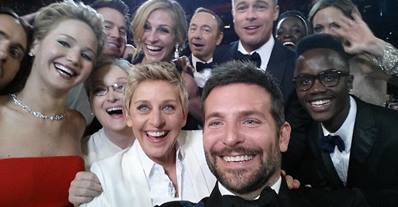

  • Years ago, when I had a chance to visit my families in the suburb of Washington D.C., I got an idea very similar to what we now know as the selfie that broke Twitter: I gathered my parents (alive then) and siblings to Sears studio for a family portrait.

    The twelve of us all crammed in a tiny space intended mostly for Holiday Greetings photos. Nonetheless, it did the job: capturing a moment in time, for a group of twelve with a given technology (people-operated, non-uploading nor tweeting).

    Unlike what happened last Sunday night at the Oscar. Ellen just gathered up the stars – all twelve – in the first rows, acting as if it had been a spontaneous idea, with the intent to tweet and retweet until Twitter crashed.

    The system was put to the test. With a lot of star powers e.g. Julia Roberts, Meryl Streep, Angelina and Brad, Ellen and Jennifer.

    oscar selfie

    We know we’ve got the technology, the attention of the public, and the product (Samsung). These days it gets to be more competitive at the Oscar than at the Super Bowl: Coke vs Pepsi, Samsung vs Apple.

    More than a Billion people on Earth, many got up early to watch it live (and enjoy seeing their Super Stars eating a normal slice of pizza in tux).

    Dream met reality. Technology intersects our need to be recognized, remembered and retweeted. As Ellen put it “instant history”.

    I only wish for another occasion for our extended families’ selfie. Years from now, we will look back at this Oscar as a definitive point where technology is finally getting friendlier and familiar even to a 5th grader. Bye Sears, and hello Selfie, however long you stay around until the next trend.

  • You – the sum of circumstances and choices – are unique. Can’t be replaced or reproduced ( in Never Let Me Go, a futuristic fiction, someone is out to make human spare parts but not the whole being).

    You leave behind environmental footprints and fine arts, scars and separation.

    Your choices are bitter-sweet, come with hidden and revealed costs. When you face a fork on the road, your instinct takes over: left is hard, right is easier but less intriguing.

    Happenstance.

    Farther and farther away from original safe haven, from the familiar porch and that worn-out Welcome mat. You have been on the journey and when you look at yourself in the mirror, you hardly recognize yourself. Mirror and weight scale. Keep checking. Keep monitoring.

    That divine spark in you is now like “object in rear view mirror”. But like rock and trees, you are created to celebrate, to make some noise. I was struck to learn that Louis Armstrong was born in Jane’s alley (mothered by a New Orleans prostitute), yet goes down in history with “What a Wonderful World”. This makes me want to join in “yeah, and I think to myself, what a wonderful world”.

    You who I have come to know, to admire and to miss seeing often.

    But I know it’s better this way, that you move on along the journey. God speed on your investment and insurance plans, retirement plans , career plans and cremation plans.

    At the end of the day, it’s the You who I remember both divine and human, hurtful and helpful. Still I invest in friendship with you. Because, you are real, even on your worst day. Everything else is virtual, illusionary and not lasting. If I had a choice, I would invest in people. In You. Because I have yet understood the whole You, who are changing with each choice along the way.

  • bowling pin

    Imagine yourself as that last bowling pin, wobbling after the other nine were already knocked down. The story doesn’t end there. Next round will be a direct hit (or try to nail down a strike). To a single pin, the bowling ball must have looked like an oncoming tornado. The pounding and impact when it hits the runway, the spin and speed. That last pin could have felt shaken to the core.

    But if it were a miss, then that last bowling pin got saved, to be recycled for the next play. The gladiator survived to see another day.

    Often times, we don’t get singled out to face onslaught, even in worst disaster. It struck good and evil people all the same.

    But each person has that “last-bowling-pin moment” when he/she must negotiate within and without to “deal or no deal”, once for all.

    Essentially, we do a SWOT analysis on ourselves while the force of opposition is coming head on.

    Legs shaken, but position already taken.

    Stand your ground. Budge not. We are like a deer facing oncoming headlight, frozen and immobile. We feel fear, numb to the point of being in denial. But if we survived a near miss, then it would be cruising from then on.

    Tragedy often comes in pairs e.g. Katrina, and looting, Fukushima and the nuclear power plant accident.

    I look for construction activities as indicators of a healthy recovery e.g. street enlargement, a bustling Home Depot etc.. anything.

    To tap into the emerging momentum. And be lifted up with it.

    Once that greater force you thought would have destroyed you, didn’t, then you are given another shot at life, a new chapter is opened in your life script. Write it well, live it to the fullest and share the bounty with others. Keep saying that  life is too short. The longer you keep at it, the more likely you will be right. After all, you  have seen nine other pins dropped and cleared out-of-the-way. Last pin standing.

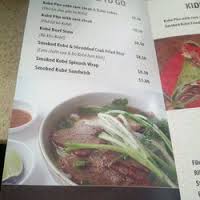
  • My first reaction to the steamy Kobe pho bowl in front of me was, wow! it’s hot. Which means, there is room to add bean sprouts and basil without cooling the broth too much.

    kobe pho

    After all, by its original French root, “feut” i.e. hot, that it got its name. Now, with add-on beef (kobe style) – American Wagyu, Japanese cows raised in the US, organically (without anti-biotic or hormone), Kobe Pho uniquely fused modern technique with ancient taste. If you ordered a French cafe-sua-da to go with it, then you got a complete Kobe House set.

    Kobe House is located in an industrial park adjacent to Little Saigon, Southern California (10872 Forbes Ave, Garden Grove). The couple who started this bakery sold the property to the Kobe House team. So the French coffee and baguette are still on the menu, while Kobe pho and Steak are added to cover your culinary need around the clock.

    Customers begin to pick up. Public taste has upgraded with base point: Cup O Noodles. So are expectations about food safety and environmental concerns. When you have the best of beef and the best of beans (coffee), you are on top of the world.

    Vietnamese has a saying ” one should try to marry a Japanese wife, live in a French house and eat Chinese food”.

    Here at Kobe House, you nail down two out of three, French and Japanese (Kobe way)?

    Everything is tested and retested, on FDA code and USDA choice.

    Just a matter of time before word-of- mouth gain traction. It’s hard to describe the dinning experience, of having the cake and eat it too: a French bakery style, with high-end low-hormone Vietnamese soup at affordable price.

    Only at Kobe House, only in Garden Grove and only in S California, a car hop from Disneyland.

  • It’s McDonald 2nd day in Vietnam. You can’t miss it (the Golden Arches), coming South from Highway 1 (North-South) as you merge into the round-about. Location, location, location. The ride-in (for scooter) and drive-in (white Mercedes at my first sighting) were roped up, to train the mass on first-in first-out monochronistic order. The stage (first-day opening) and event staff still linger (one young man w/ side-way cap to differentiate himself from McDonald workers). Kids traveled by bus just to get here for the experience. It feels more like an amusement park more a fast-food launch. But then, both are into “experience” business e.g. clown, children air castle, and maps showing first-timers how to use drive-in windows (same thing happened in China, since drivers there were unaccustomed to drive-in).
    Pre-orders were taken while you are in line, enabled by handheld touch pad, the same technology that makes our rental-car return a positive experience. I already had had my porridge lunch, but still tried to squeeze in a cheese burger and an ice-cream cup. This 2nd lunch cost twice as my first one, but the pickles were true to form. All out of curiosity.
    Years ago, I had my first McBite at Penn State (see other blog)
    I remember McDonald back then more for its fries than the Whopper across the street.
    Now, that franchise brands are all here (Pop Eyes is right next door), with 99% available elements (I tried to order a milk shake to no avail. This should make Ray Kroc mad, given his pre-McDonald career as a milk-shake maker route salesman.)
    Staff, some trained on the job, others newly recruited, perhaps fresh out of McU. The majority are in their early twenties, mixing with expats who serve as launch specialists. Inter-racial couples come on scooters, just to show the democratizing effect of the McDonald brand. Two countries with a McDonald are less likely to be at war with each other (Friedman’s espoused version on an old geo-political theory). In this case, it’s even less likely (what are the odds of getting hit by lightning twice in your lifetime?).
    Customers were chatting and munching one fry at a time (two ketchup bags) to prolong this one-of-a-kind visit.
    It’s more than a dining experience. For McDonald, the launch in Vietnam was well-timed with the right product and right location (Burger King and KFC have paved the way for this big flash).
    The positive unintended consequences are benefiting adjacent neighborhood, who offers their sidewalk for scooter parking (small bike 5,000 VND, big bike 10,000 VND) and lunch places for McDonald staff (they still can’t afford to eat three McMeals a day). Last year, when Starbucks came, it made a flash just as big, then plateau out.
    When looking for a place to empty out my tray, I got teary eyes all of a sudden: my first McBite in the US was associated with loneliness (why else would a foreign student seen eating dinner alone in a fast-food joint off campus), and now, my first McBite in Vietnam surprisingly evokes homesickness (what else can an expat do on a Sunday afternoon when he doesn’t take a nap like everyone else). The sweeping force of modernization which McDonald just happens to represent nudges us along the efficiency trajectory. Kids get dropped off to English school a few blocks away, even on a Sunday afternoon. Next week, when the ropes will be all removed, I wouldn’t be surprised to see them carry a Happy Meal bag along side their book bag. Just watch the waist line, kids.
    The future belongs to you, and that future gets stretched out due to longer life expectancy. Brace and pace yourself for the long haul. Beware of anything that comes with “instant” like instant noodle, instant success ( Flappy Bird, a free game that had gone viral from Vietnam, saw instant success, and that was too much for its young inventor to handle).
    There will be a few hic-cups (no milk shake or McCafe just yet, or that the real test comes in the rainy season), but by and large, young people here are on the right path, given the right opportunity. Opportunity which tends to dance with those who are already on the dancing floor. Had they pushed the fries, I would have declined .It’s not my first McBite and I don’t want this to be my last.

  • Recent studies show more American graduated from all levels of education than before the Recession. Other studies show older ones also tried their luck at start-ups and social entrepreneurship.
    The first group just stay out of the depressing job market. The later, creating jobs for themselves and others, all the while, learning on the job to be their own boss.
    I suspect there is another unaccounted group called stay-at-home dads or moms who try to save a few baby-sitting bucks.
    Low-end restaurants like Panera Bread, hybrid between fast foods and Olive Garden, are holding out.
    Japan faced similar changes in the 90’s with corporate lay-offs (unthinkable a generation before that), massive shift in post-industrialized world with people becoming quite disposable and machine quite acceptable.
    By next year, we won’t even need someone to check our ticket or take our cash. Just swipe the card (translation: less available blue-collar jobs) or stay home waiting for Amazon drone-delivery (at least conceived and mentioned in passing).
    I blogged some time ago about Machine and Me. It’s true that one can go about one’s day without a single human interaction. Chains like Carmax build their business model on no haggling i.e. car buying = appliance buying. Since each touchpoint is minimized, I also blogged about Hi Tech – Hi Touch, our increased need and hunger for organic relationship (now that we move on and off-line, just like a Toyota hybrid).
    The Recession was partly caused by greed, but also by a confluence of factors such as regulatory blind spot, data-rich market on steroid (how else would Iceland get hit just equally hard, being miles away from Wall Street) and government reduced spending (post-cold war world).
    Now, on this side of that economic tsunami, we pick up the pieces, while some people pick up their doctorate degrees or business licenses.
    99 per cent of the population got hit in one form or other.
    Or have a close relative or friend who did (unless they were in Healthcare).
    Implying in Learning in Recession, was Living in Recession.
    We are still here. Hopefully wiser, but certainly not without paying a high cost.