Fools ignore facts

In all my stops in London, Zurich, Cote D’Ivoire, Monrovia, Ghana, Hong Kong, Manila, Mexico, Montreal, I formed good impressions of each locality and people. When I came back to Vietnam in 2000 and on subsequent trips, I did the same even in the worst of scenes e.g. how could that guy without legs drag himself on the street selling lottery tickets!

But this kind of lens Joel Brinkley did not wear on his trip to Vietnam last month (I was still there then). He came back, and wrote that Vietnamese ate anything that moved “birds and domesticated animals are rarities on city streets” and that he saw one lady in Da Nang sell field rats..” this rich in protein diet drove the Vietnamese to attack peaceful neighbors e.g. Cambodian whose diet had less meat.”

Now he made me paranoid! With the same observation, his steady Big-Mac diet could turn out to be a threat to his journalist students at Standford (who could be 100 per cent sure what’s in the “rich in protein” fast foods).

Our Canadian neighbors to the North love eating quails. French, horsemeat. Even in IKEA products.

Regionally, people responded to scarcity and starvation differently. If he had read Guns, Germs and Steel, he would have known that it’s the lack of anti-bodies (against invaders’ germs) in the native population that killed them more than all the aggressors’ guns put together.

I know what Vietnamese drinkers do and look for. They call it “moi”. It could be appetizers such as roasted peanuts or fried tofu, from escargo (French) to eel (Korean). Vietnam explores and incorporates many strands of culture and cuisine (recent article showed wider adoption of wine, but still not the cheese – due to lactose intolerance).

On the day Joel Brinkley published his opinion piece on the Tribune Media site, by a stroke of luck, the editorial oversight was asleep at the wheel. I was saying goodbye to a friend over a beer (E European) and fish. Luckily, the joint did not serve dog food, or else I wouldn’t be writing this piece of cultural defense in good conscience.

I helped circulate Mr Brinkley’s piece to a network of friends, but did not sign the petition as many did (petition for his removal from post). It said he should have practiced what he preached i.e. fack checking before forming an opinion, observe before conclude, and learn the difference between cause and correlation.

People in Korea, China, Vietnam country side did eat field rats in hard times. Perhaps they want to go back in times (Post Traumatic Stress Disorder) bonding over beers (therapeutic more than ritualistic). I once shared a meal with Filipinos over the weekend. We ate without utensils, the native way. It’s their “letting the hair down” time, away from the monotonous rhythm of the Western style cafeteria. And I was glad to be included. Felt like Margaret-Mead then.

I would not fall into a trap to argue that, yes, I saw rats and heard birds in the city while I was there. It would not be cool if I am pressed about where (in the alley, because I took a short cut to shield myself from the scorching sun).

But for someone who wrote a scholarly piece on Cambodia, then to make a 10-day stop in Vietnam, all the while living in a group-think bubble (expat cocoon riddled with colonial jargons) just to write-up a piece that stirred up controversy and resentment, was uncalled for. I remember my Communication professors at Penn State. They earned their stripes and their respects. Joel has to earn the prizes he had already received. In the beginning, was the Word. Noble and enabling word, that builds up not tears down. He probably is tasting a spoon full of his own medicine these days, and wishing he did not make those comments. Teachable moments for both prof and students. Just as we thought we could put Vietnam to rest. BTW, a friend in Ghana who took me to his home offered me foods full of tomatoes and hot chillies. And their dark skin was quite shiny and healthy. I don’t think Ghanaian attack any of their neighbors either. Most wars I read about involved McDonald eaters. Or hit and run  Or drive-by shooting. Want me to open the box? P.S. In Talk Vietnam, there is a parody in which the author took a tour in the US and couldn’t find any livestock here either. All eaten!
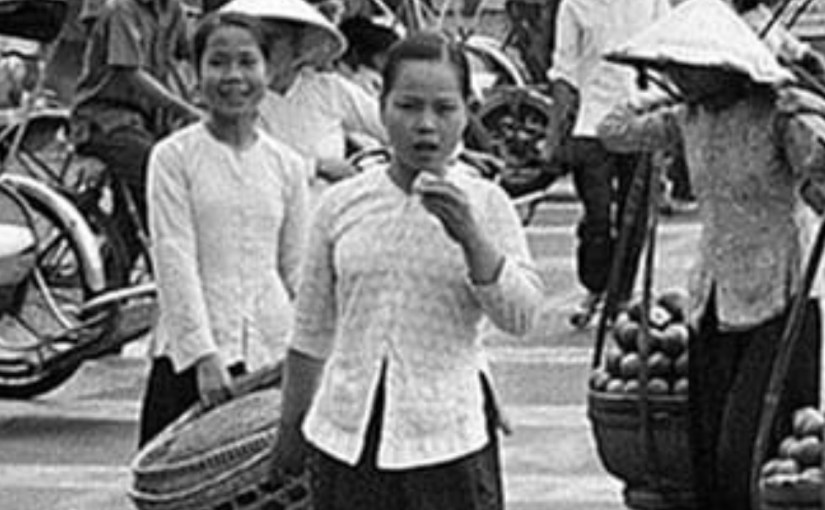
Go a bit more native

In 2000, after 25 years of being away, I made a short trip back to Vietnam.

What a culture shock (especially when I landed in Hanoi, where I had only heard about).

Twelve years. A dozen trips later. A little deeper into the alleys and byways.

I think I have touched on different parts of the proverbial Elephant.

Vietnam now has malls that are as sterile as the ones in the States (on weekdays).

The first Starbucks is having its soft-opening.

Raybans, I-phones and Vespas are as common as the remaining rice fields.

French colonial presence is confined in the centres with boulevards and sidewalks (just like in Cote d’Ivoire). But urban sprawl doesn’t stop there.

At the outskirts of Saigon, shops after shops compete for retail customers.

Fresh flowers are shipped in from the highland just in time for Tet celebration.

Coffee shops with Wi-fi serve up tea to go with coffee (East and West blended).

When you see a bunch of well-dressed Asian get off a bus, you know they are APEC tourists.

Or else, backpackers would try to hopelessly blend in with flip-flops and shorts. Lonely Planet. I read that guide on my first trip. Now, I rely on instincts and instructions from my taxi and scooter drivers.

Like any city, Saigon is divided into various social strata The upper crust lives behind iron-gates and tinted Mercedes.

Everyone else, crowded flats and scooters, wearing required helmets and optional surgical masks.

Fortune are made and lost here. One bubble after another. 1997 and 2008.

Not as severe as in Thailand. But the poor have always suffered, below the radar. They will probably continue this trajectory for a while, even with more foreign investments. With brands like Nike, Intel, Starbucks, KFC and Jabil , change is undeniably in your face.

Vietnam has grown out of the “war” box. It has evolved into an emerging market and “Happy” country (behind only Costa Rica). It is worth visiting and studying.

While people are increasingly materialistic, that alone is not what makes them  happy. Perhaps with the right mix, one can be content.

Let’s not forget, people do share the spoil, which makes them materialistic, but not yet individualistic.

To give is more blessed than to receive. But not for long since the mono-chronistic, individualistic and modernistic cultures are invading, and people start putting up fences and walls. Fences make good neighbors, as Frost put it.

But it also slices away those invisible connections people are born into for centuries, before the French, the American, the Russian and the APEC people arrived under the pre-text of global village. In truth, what do we know about life in a village? I certainly don’t. The US arm forces didn’t. Nobody did, except the people who had lived there, and now are living in the city. They too wouldn’t tell (I found “After Sorrow” by Lady Borton quite informing).  While I try to go a bit more native, they went the opposite (urbanized). Somewhere in between, we cross-path like two ships in the night. Oh, don’t forget to bring cash if you want to go a bit more native.

Flowers on concrete

It’s time to celebrate. Harvest time.

City folks here in Vietnam go home where beer and Banh Chung (Bean Cake) are waiting, while country folks truck in their flowers and fruits in the opposite direction to sell in the city.

This year, we don’t see the return of H5N1. So eat on. Chicken and ducks.

A friend of mine has an orchid farm in Da Lat. He could hardly come down for a visit . Too busy.

I am glad for him. Harvest time. The dead even got their joss paper money burned by the living as Holiday spending spree.

We chatted about cemetery in the States vs here in Vietnam. People did not know that in New Orleans, LA ; people were buried in stack-up tombs (below sea level, which occasionally broke the dyke as happened during Katrina).

The French left their architectural signatures both here in Vietnam and elsewhere like in New Orleans, Montreal and Cote d’Ivoire.

In Paris, they managed to keep traffic out of the city.

Here in Saigon, people  build out which means more congestion even when commercial trucks are restricted to off-peak hours).

Young students are eager to go home. This will ease traffic for a few weeks.

Perhaps there will be enough space for flowers to be sold on concrete sidewalks.

Flowers remind city folks of “Green Field”, lush country as seen in “Good Morning Vietnam” (soundtrack by  Louis Armstrong’s What a Wonderful World). Those green fields got sprayed years ago with Agent Orange, whose long-term destructive consequences are still being sorted out.

Yet, lovers still “parking” in the parks, vendors still selling bouquets (for households to decorate their shrines).

A Vietnamese New Year song aptly says it all “Wishing the farmers with great harvest and young lovers their love nests. So let’s toast” (notice the imagery : harvest and nest etc..). Tet is inclusive, not just for city folks, or just the living. It’s democratized to include the afterlife population.

With the dead and undead join in, concrete or chemical can’t stop the sprouting of flowers on concrete.

The Vietnamese pleasantry

A few days ago, we were entertained with a lavish meal, of all things, in a  wedding banquet hall. Being the first customers that evening, we ate in this huge wide open space.

One by one, the dishes arrived. To me, that’s a lot of cholesterol in one shot. But I couldn’t get enough of hospitality and genuine friendship despite the poorly executed ambience (they could have partitioned the hall to get better ambience).

Human connection more than often transpires space and time. Two friends can pick up where they left off  last time, be that a decade or 40 years in between. The old “bookmark” was a good place to start. From there, it’s time to mine empathy from those of the same frame of reference (in Netherland, the writer touched on an emotional soft spot often experienced by immigrants in America). It’s still unclear whether brave decisions, like that of Steve McQueen in Le Papillon ( to escape 7 times) was better than that of Dustin Hoffman‘s (to stay and plant tomatoes).

During and after the war, millions of Vietnamese scattered to the four winds, to neighboring countries or far-away ones (I met a family who open a restaurant in Cote d’Ivoire). I have seen how they shop, live and communicate (and sometimes, send back money). A notable experience was three-time evacuees from E New Orleans (North-South, East-West, and lately, Katrina returnees to rebuild more quickly than first-timers).

Given the historical context of getting “smoked out” of their villages, the Vietnamese overseas are quite brave in their own terms. The cultural gap couldn’t be wider (as compared to the wave of  European who first arrived to the US .) Yet, they thrive and survive the down turn, sometimes, by doubling or tripling up. Not as physically strong as the Mexican day laborers, the Vietnamese average workers ended up in assembly lines (Silicon Valley in the 80’s, then scattered all over including RI) holding on to jobs that have yet been shipped to lower-wage countries. Once out of the box, Vietnamese women have stepped up to be leaders of the families.

En par with American counterparts, they juggle cultural expectations, career choice (majority of whom as manicurists) and family obligation (in-laws living under the same roof). I have observed first-hand how my mom, a woman of mere 5 feet, tackle those various demands. In her lifetime, she faced two evacuations, spoke two languages and still managed to amass a huge savings from three decades of school teaching. It’s ashamed that those piles of money had to be tossed at seas during our trip to America.

Still, the grace and courtesy follow these women to strange shores. There, once again, they hold the steady hands of paying customers, assuring them that life can always get better, all along, bluffing and buffing. To them, no matter how it was inside, it is mandatory to show only their outward pleasantry.

(Yoko recounted this in her NYT op-ed,  that her late husband JL, protected her still to this day, every time she put on the shaded designer glasses to face the world, “don’t let them know they got you”).

Who would  know, behind those nail polishes are stories of left-behind treasures and broken dreams, and the smiles served as bribes to a better life. I owe this to one of those amazing women. Always pleasant with an enigmatic smile large enough to cover all the years of sorrow and struggle. The Vietnamese pleasantry.

Cote D’Ivoire as I recall

I set foot on Cote d’Ivoire  summer 86.

Abidjan looked like former Saigon. Both were built on French architecture template.

Next door Ghanians got shinier skin. But hearing French spoken by the people there made me feel at home. In fact, so at home that I, upon discovering a Vietnamese restaurant in town, stopped in for lunch. And they did not even take our money. Fellow countrymen, in a foreign land, as far away as one could possibly imagine.

The owner mentioned about flights from France that would supply needed ingredients for egg rolls and other authentic Vietnamese dishes.

They must have been one of the very few early Asian settlers in the country.

Then, yesterday, on the Newshour, we watched Peter Pham, expert on African affairs, interviewed for the segment on current regime change in Ivory Coast.

I have seen his book on Africa‘s affairs. And to hear him on air, was just as delightful.  The word “positive deviant” came to mind.

Instead of rebelling against strict parental and cultural codes e.g. pressures to become a doctor or an engineer, some people harness their passion to pursue something totally “deviant” but with a positive spin. And Peter Pham was one of those. Vietnamese, but expert on African affairs.

A few years back, I was also surprised to see a Japanese expert on Vietnamese language.

The depth of his knowledge about our culture and language would put any of us to shame.

There certainly were some drawbacks being born outside of the culture, but this also is made up by his objectivity and relentless pursuit. In short, he went in deep.

My short stint in West Africa was my attempt to understand a culture so different from mine. To experience the world via someone else’s eyes.

In Liberia and Ghana, I relied on English to communicate. But in Cote d’Ivoire, I was forced to pull out language I acquired in my early years. Oui, oui.

I wish for the people of Cote d’Ivoire the best, when the country can be stabilized and rebuilt to its former glory.

Its boulevards and police posts were so Saigonese that I felt at home there all of a sudden. That kindred feeling that is reserved only for relatives.

Former colony, fellows of the same dreams (in French, of course). I am sure people there can recognize Alain Delon, BB and Catherine Deneuve in an instant.

That was in 86. I don’t even want to venture about its current state of internal warring. And how a hotel that turned compound for the President-in-waiting can accommodate that much aspiration for change and modernity. Any disruption, if well-capitalized, can be turned into opportunity for growth. The continent is awaiting to see if election model work out for this former French colony. All eyes are on Ivory Coast, including mine.