3D and 4G

At the most elementary level, we got the chip set.

That is about to change, from “flat like a sheet of paper”” to 3D chip, announced Intel (which made Applied Materials jump to its 3.9 Billion acquisition of Varian Semiconductor to keep pace).

Our world is about to change once again, not to the tune of 10 Billion by 2100, but 10 Billion people communicating at the speed of thoughts. At this rate of growth, we can see 3D printing soon to be a norm.

You think that self-check-out at Wal-Mart is bad. Think again. Someday, we might end up ordering an item, only to have it print out at home (watch out UPS).

We’ve got “make your own stuff animal” stores and self-serve ice-cream machines.

Our homes are about to become mini-factories, and stay-at-home dads, in-sourced blue-collar workers (Dad, I want fresh bread. Dad, please squeeze the OJ. Dad, grind the coffee beans, please).

It’s only fitting that the last known WWI vet died leaving behind a changed world.

The US itself, in order to stay in the lead, will have to become world incubator of innovation and ideas.

CNN’s United States of Innovation (51 ideas from 51 states).

Think heat-sensor technology, facial recognition, speech recognition, drone, SPAM prevention, social marketing, Facebook/Skype , Utube and YouTube. None had been around when Bill Gates penned “At the speed of thoughts” (as of this edit, MSC announced it would buy Skype at the tune of 8 Billion dollars).

Now we have professors talking about $300 houses for the bottom 2 Billion (the last time, they couldn’t make a $300 computer). Incidentally, the Hyundai’s Excel got its start in the US at the price of $5,000 where the Nano’s starting price is.

To sustain innovation, we need clusters (and luckily, from the trajectory of history, our times seems to be one of those according to Steven Johnson in “Where good ides came from”). Clusters such as Seattle, San Francisco and Austin.

A little dose of music, art and literature, mixed with a heavy dose of tech, geeks, and flower children (rebellious streak).

Ironically, people who are into their own world (eccentric) are not people who can soup up for a fund-raising session with VC’s.

For now, commoners like me can’t wait to see what comes out of 3D chip set and 4-G broadband.

When all those dark fibers got lit up, and cloud servers turned on , let the show begin.

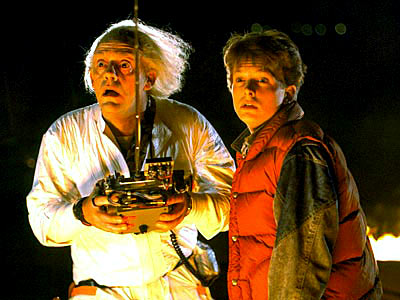
Like Back-to-the-Future scene, we might get blown away. I suspect that won’t be the case. Change will come sporadically, with an app peppered here, and a tweaking there. Before we know it, we can design and print our own T-shirts at home.
That’s  what makes Chinese authorities awake at night. What are they going to do with the over-invested infrastructure we now call, world factory. And all the men, unemployed, then, already experienced a bite at the proverbial apple (the middle-class life style). History always reserves its best twist of plot for the end. I wish I be around to witness it, like our WWI last known pilot. RIP man of the greatest generation who lived and fought in a pure mechanical universe. We all need to have 2-D chip before 3-D, PSTN before Skype. “Hello, if you hear the sound of your own recording, you are on, for free”.

Against the tide of commoditization

In Selling Professional Services to the Fortune 500, Gary Luefschuetz warns against mix and match people and rates of various service tiers, which will compromise the rate structure. In short, swim against the tide. IBM got it. Cisco follows suit. And HP is moving in that direction.

The Economist takes an in-depth look at IT future. One dominant theme is ” smart” infra-structure e.g. buildings,water, electricity, appliances… even cows). First, we were glad to get our white bread sandwich neatly cut and refrigerated. Then we want it toasted. Finally, we want the toaster to beep like our microwave oven.

The key to all this is inter-connectedness. From blue-tooth to Blu-ray, RF to RFID, we are moving up the value chain.

Years ago I remember watching a demonstration of hologram at Penn State. Professor Roy Rustum was there among the observers. He later was quoted as saying “I felt the chill in my spine” when his crew at Material Sciences Lab discovered electricity conductivity in water. Now we got 3-D hologram to watch the re-release of Star Wars.

At the high-end of the OSI model is the application layer. This is where our imagination pays dividend.

The physical layer move their facilities off-shored to accommodate better rate structure.

Samsung is slated to be a strong contender in the tablet space against the I-pad with huge facility in North of Vietnam.

I also remember watching the young CNN news gathering crew (in black T-shirts) back in the early 80’s. CNN manages to stay above the fold in the cable news business. That business gets commoditized as well since we can now access hundreds of them.

For CNN, the secret sauce has been their first move advantage, and continuing risk-taking (Gulf war). David Brook of the NYT puts it simply “branding is an effort to decommoditize commodities”.

While companies are in a race to produce “smart” applications, schools and companies should retrain people. Smart people created smart appliances. And smart people take calculated risks. Leaders of India and Ireland saw the hand writing on the wall. They moved swiftly to retrofit their nations for the  21st century, not only in IT, but with new ways to solve existing problems e.g. micro lending, mobile banking, cheap automobiles etc…(see The Miracle).  I read the review of Chevy’s latest small car, the Cruz. It took GM, once the largest corporation under Alfred Sloan, 40 years to reduce its automobile size. May the best car win.

The temptation to compromise and mix the different tiers of services led to the downfall of many sectors, especially telecom.

(South Asian agents and resellers first question was normally, “what’s the rate”).

So I wasn’t surprised to read in Fortune magazine about Verizon’s soon-to-be-rolled out Android perfect phone. Can you hear me now.The old GTE has swam hard against the tide, to become the premier wireless company.

Choose your battle, pick your turf, and retrench at the highest service level.  Who wants to stand next to those robots who don’t get sweat or take smoking break.  And I am sure, after the next round of cost cutting, they still stay until robot 2.0 version displaces them.  At Twitter, those guys didn’t even use up the allotted 140 characters. They tweet simply “Be helpful”. I take that to mean swim against the tide, to offer relevant and helpful service to a market gluttered with commoditized services.