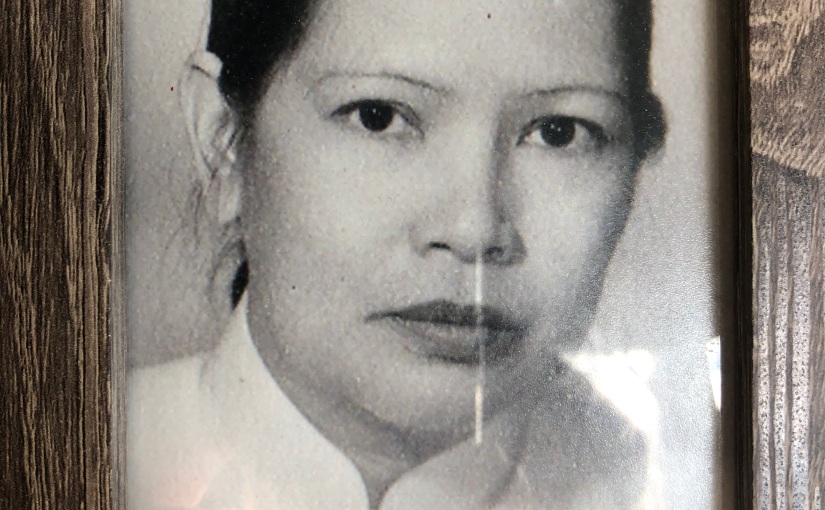
Mom’s Ao Dai

When I saw a Vietnamese woman on motor bike with helmet, mask, sunglasses, messenger pouch, gloves and Ao-Dai steering her scooter while holding a baby on their way to the sitter, it brought back memories of Mom’s dress.

She was a schoolteacher, deeply committed to and consistent in her multiple roles: mother, teacher, wife, daughter-in-law and friend (to colleagues who also migrated South, all graduated from the same French Lycee up North, which in her times, was big brag!).

Having spent her semi-orphan childhood in dormitory, she made sure we have what she had not: a loving home with home-cooked meals.

Untrained and untutored from day 1, she tried most times, without even taking off the Ao Dai from work. By design or default, she had a good assistant: me. Here, hold the live chicken legs while I slit its throat (all the while, she would pray for its soul – after all, it had been predominantly an agrian culture, with eco and ethno cyclical living in harmony).

Then she would place the boiled chicken on the altar – an offering to our ancestors on the days leading up to Tet or special occasion of extended families gathering to memorialize ancestors.

I learned by observing and via osmosis (run to the market and get me ginger) and by serving/cleaning.

And clean I did, on the cusp of New Year. Mom would put on her Ao Dai right before mid-night, light up three joss sticks and pray to the four corners of the Earth. There was something so sacred (and safe in the midst of a lightening hot war) at countdown. Inspirational enough to my parents who often competed to compose and read aloud a stanza or two to each other (both were well-versed in French …Lamartine, Chopin and Flaubert). Now lost, but once around, a family photo carefully kept in yellowish album, showing their “mon dang ho doi” wedding, on par with Sicilian B/W counterpart minus the dance. Mandarin don’t dance.

I meanwhile tried to finish up my last rinse for the floor in anticipation of a throng of visitors.

Back then, you could hear occasional boom and bang (Chinese enclave was known to spend a fortune on firecrackers e.g. shades of pink and red – color of fortune, evident in spent shells carpeted their lawn, our version of V-J Day ticker-tape parade).

The whole region threw a big New Year Eve party that makes even the dead want to join in.

Years later, Ao Dai evolved in style (Madame Nhu), hence rid of the collar as temperature often rose above 100 Celsius.

But not for my mom.

She stayed on in that northern teacher’s style all the way to NE America, where once again, she trekked snowy roads to the Temple on New Year’s Day. I knew then and even now, she had prayed for me, her youngest who has never traveled traditional safe path (heck, I was too young and too late to the Sexual Revolution of the 60’s).

In contrast, the Road Less Traveled strayed me far from our proverbial tree. The first few feet on student car were the hardest, seeing her wave from my rearview mirror.

This made it hard my whole way to Windy-City Wheaton, to grad school and an uprooted life.

Her picture has been on my altar. I wonder what gift I should get to make worthy a Tet offering (bean bun, bouquet and beer?) Banh chung, bong cuc va bia?

Perhaps the best way to honor and keep her memory is to be the best son/student/self.

I don’t want to see in the rearview mirror shadow of regrets. I realize the only way she could have let me go was for furthering education. Of any in my family, she would be the one who understood it best. Always among the 57 students, year after year, at times, second-generations, for 30 some years, marshalling and motivating them with words and deeds.

When seeing a younger version of her going to work in scooter, mask, glasses and helmet, but still in Ao Dai (Vung Tau resort reception?) holding a baby to the seaside babysitter, I was reminded of her: sacrificial and selfless, a role model to show us the possibility of reaching higher, rising from four feet to become worthy bi-pedalist. Her contribution made our human race all the richer i.e. man shall not live by bread alone.

Si tu n’existais pas, I wouldn’t be here. As a humble keeper of fine and fond memories.

Mom’s Ao Dai

Encoded memories

In a fictional tale of modern madness, the author of “the Remains of the Day” brought to us “Never let Me Go”.

A famous quote from the school principal (where students were raised and taught to become “donors” since they were genetic copies made from real people to someday called on to offer their body parts as spare parts) about the students’ art projects “We let you experiment – with arts – to see if you had any soul at all”. That line stuck with me, and it dawn on me we have been fed almost that same line since Taylor pressed the On button to start the conveyor belt. Workers’ input are not welcome. Just screw in the bolt. Just do it. (Modern Times, by Chaplin).

Then arrived Taylor 2.0 (Toyota Continuous Improvement) where workers are welcome to stop the conveyor belt should they find something unusual.  Hence, the age of empowerment. Workers are now welcome to take part in production and discussion. Third phase is happening, to bring user’s input into the production process (T-shirt design and production).

Companies, like people, have stored up years of experience, we call “know-how”. 3M, Symantec and Adobe are where they are today because of their core competencies. They have created an ecosystem of stake holders who care. Consumers likewise feel safe when purchasing their products. Post-it-notes, packing tapes etc.. from 3M command higher prices than its nearest competitors. The power of brand.

Turn on your TV today, you will see London reasserts its “brand” reputation for 2012 Olympics. Rome also got some share of air time, while Lybian uprising was temporarily forgotten. So was the Midwest tornado. Our attention-deficit economy in a 24-hour news cycle.

Apple got to where it is today because it paid attention to the “soul” part of the electronic experience.

First people wanted something smaller than the mainframe.
Then they want “desk-top publishing”.

Finally, they want to “express” themselves (life-style) with Nike+/Apple  I-pod.

When I ran the 8-mile golf course at Penn State, I only had a pair of shoes and shorts.

I thought about the future during those 8 miles (that future is now being lived out), just like Madame Nhu’s pronouncement “I am not afraid of death” back in 1963. She finally had a real encounter with that unknown last Sunday.

Companies like people, stored up millions of  memories to act, react and interact with different set of circumstances.

If the person or company stored up many well-learned lessons, they will come out ahead in adversities (e.g. product recalls).

Conversely, negative memories predispose a person or company to repeat that vicious cycle (i.e. patent infringement, disregard for workers’ rights and environment/ethics).

Companies and people also reinvent.

M&A is just an euphemism for erasing bad reputation, or bad numbers .

It’s not even a make-over. It’s a brand salvage.

They just count on public amnesia. To go back to Taylor 1.0 with the conveyor belt. Just Do It. Think not about tomorrow.

Even the company which gave us the tag line “Think” (IBM) now sold off to Lenovo who owns the rights to its Thinkpad.

I am glad we have not only soul, but also memories. Together, they come in handy against weapons of mass distraction. We do remember, some of us. Never let that go.

Unintended influence

We are influenced most by our 2nd or 3rd degree connections.

I grew up hearing stories of the past (almost 2 million people died in the 1945 famine and how my great Aunt took my mom and siblings in since she had a tea plantation etc… my Anne Frank version). Consequently, I strongly believe in Paying Forward (I wouldn’t have been born later in the South if it hadn’t been for  great Aunt Dieu, my vertical 2nd connection).

Taking that a notch further, we benefit greatly from the courage of the Wright brothers (who braced themselves for the Beta-test of those early airplanes) to the soon ubiquitous RFID technology (which reduces the costs of inventory and supply).

ARPANET gave us access to a vast amount of data on the Web. Storify and Spotify help us sort them .

I saw an ad yesterday which spanned from horse carriage, to internal combustion engine, to today’s hybrid Infinity.

Even failed technologies contributed to our collective repertoire. Or failed states and statesmen (women).

I read about the passing of Madame Nhu (Vietnam’s Imelda Marcos, minus the shoes collection).

http://www.nytimes.com/2011/04/27/world/asia/27nhu.html?partner=rss&emc=rss

She was on a PR/shopping trip on Rodeo Drive when her brother-in-law’s regime collapsed, rendering her stateless.

Her unintended influence was more in modernizing fashion than in abortion ban.

The Ao Dai (long dress) during her time came without the collar (her casual-Friday version). She must have taken a page book from Paris Match and Life  (Audrey Hepburn). This week, we won’t go anywhere without seeing those Spring dresses and hats, coming to us from London.

Ironically, as France banned the veil and head covers, Britain welcomes back the hats (might you the security camera angle. These society ladies don’t do ATM or violate stop lights.)

Back to our 2nd and 3rd degree influence.  What key words will land searchers on our page? Will future anthropologists – or Third Generation Viet-American, conduct digital forensics, the way they do in China upon discovering a 2,000 year-old Mummy, to find our “upload” an unintended influence?

I only know that small act of kindness to relatives and people in need, as happened once in my extended families, enabled our migration to south Vietnam (instead of being counted among the 2 million deaths). For my turn at unintended influence, I promise not to say things like “the monks are welcome to barbecue themselves” ( 1963 monk self-immolation to protest religious persecution).

It’s hard to earn a good byline these days. At least in one case, the NY congressman whose half-naked pic went viral, resigned immediately. Madame Nhu’s unintended influence, however, was to encourage Vietnamese women to “stick their necks out” during war-time. The same thing happened to American women during the two World Wars: replacing the men who left the factory for the front.