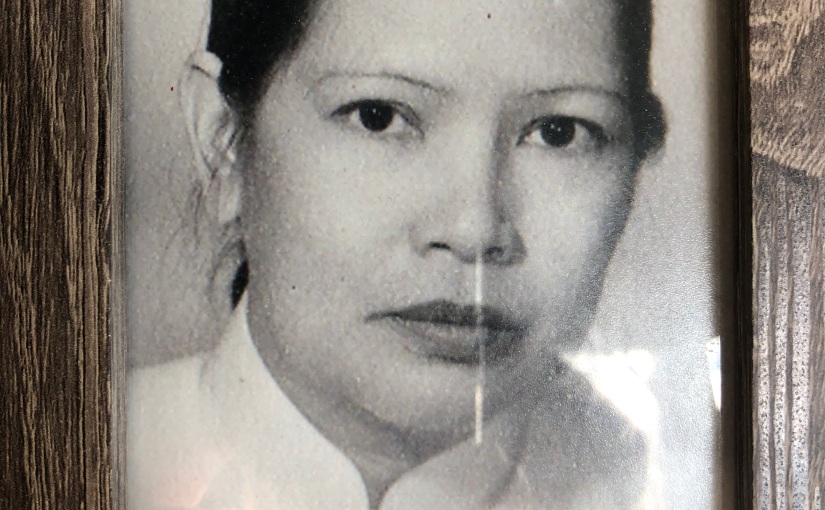
Mom’s Ao Dai

When I saw a Vietnamese woman on motor bike with helmet, mask, sunglasses, messenger pouch, gloves and Ao-Dai steering scooter while holding a baby on her way to the sitter, it brought back memories of Mom’s dress.

She was a school teacher, deeply committed to her multiple roles: mother, teacher, wife, daughter-in-law and friend (to other teachers who had graduated from the same French Lycee, which in her time, was a big brag!).

Having spent her semi-orphan childhood in dormitory, she made sure we have what she had not: a loving home with home-cooked meals.

Not a good cook, she tried most times, without even taking off the Ao Dai she had on from work. By design or default, she had a good assistant: me. Here, hold the live chicken legs while I slit its throat (all the while, she would pray for its soul).

Then she would place the boiled chicken on the altar – an offering to our ancestors on the day leading up to the New Year (Tet).

I learned by observing and via osmosis (run to the market and get me ginger) and by cleaning.

And clean I did, on the cusp of New Year. Mom would put on her Ao Dai right before mid-night, light up three joss sticks and pray to the four corners of the Earth. There was something very sacred at New Year countdown: inspirational enough to my parents who often competed to compose and read aloud a stanza or two to each other (both were well-versed in French …Lamartine, Chopin and Flaubert etc..).

I meanwhile tried to finish up the last rinse for the floor in anticipation of throng of visitors.

Back then, you could hear occasional boom and bang (Chinese enclave was known to spend a fortune on firecrackers e.g. shades of pink and red – color of fortune, evident in spent shells which carpeted their lawn, our version of ticker tape parade).

The whole region threw a big New Year party that makes even the dead want to join.

Years later, Ao Dai evolved in style (Madame Nhu), hence rid of the collar.

But not for my mom.

She stayed on in that teacher’s style all the way to America, where once again, she trekked snowy roads to the Temple on New Year’s Day. I knew then and even now, she had prayed for me, her youngest who has never traveled traditional safe path.

In contrast, the Road Less Traveled took me far from the proverbial tree. The first few feet were the hardest, seeing her wave from my rearview mirror.

This made it hard the whole way to Chicago, to grad school and to an uprooted life.

Her picture has been on my altar. I wonder what gift I should buy to make it worthy a Tet offering (bean bun, bouquet and beer?) Banh chung, bong cuc va bia?

Perhaps the best way to honor and keep her memory is to be the best son/student.

I don’t want to see in the rearview mirror shadow of regrets. I realize the only way she could have let me go was for furthering education. Of any one in my family, she would be the one who understood it best.

When seeing a younger version of herself in scooter, mask, glasses and helmet, but still in Ao Dai, holding a baby on her way to the seaside babysitter, I was reminded of her: sacrificial and selfless, a role model with near spot free existence. Her contribution made my and our human family all the richer.

Si tu n’existais pas, I wouldn’t be here. As keeper of fine and fond memories.

Mom’s Ao Dai.

Burning flesh, jasmine scent

I used to live just a few blocks from where it happened on that fateful day in 1963.

As an active kid, I joined the throng to witness history in the making: monk’s self-immolation as a peaceful act of protest against the Diem’s dictatorship.

The city had been permeated with the smell of tear gas on days leading up to this event http://www.time.com/time/world/article/0,8599,2043123,00.html

We rubbed lime to soothe our eyes’ sore.

When I read about Tunisians tweet and text to recommend Coke for eye relief, it brought back memories .

The jasmine revolution got its start from those similar flames. Flames of conscience objectors who preferred death to drift and dignity to dumb-down.

We have watched with incredulity how a Zippo flip from Tunisia could inflame the streets of Cairo.

And how quickly the scent of jasmine spread in carosene region .

People pray and people pay the price (thanks to the doctors who bandaged the wounded) to bring down Pharaoh. Instead of casting votes, they cast stones. As I can recall, it was serene and surreal at the intersection of Le Van Duyet and Phan Dinh Phung street . Young monks chanted quietly to send their master to Nirvana. There were a few hundred present at the event (including an award-winning NYT war correspondent).

This slideshow requires JavaScript.

Peaceful and principled.

Every body knew what it was all about: the Diem’s family ruled the country: big brother was president, younger brother – head of internal security, and his wife, unelected spoke person for the regime. Madame Nhu was quoted in a press conference (perhaps on her shopping trip abroad, though not for as many shoes as counterpart  Imelda Marcos) “they are welcome to barbecue themselves ….”

History recorded that her husband and brother-in-law, dictators of former Vietnam, were assassinated on their way to the Chinese District. Their deaths weren’t honored and their departures not as peaceful as the monk’s. “What good for a man to gain the world and lose his own soul”.

If you were to witness that sudden burst of flame, and the resolute stillness of the monk, you, like I, would never forget. It will be the same years from now about that jasmine scent that floats from Tunisia to Egypt and onto Libya.

Use lime, it’s better than Coke.


Vietnamese love for French songs

When traveling in Vietnam, you can still hear French embedded in every-day culture:

fork (fut-xet) , suit (com-plet) and tie (ca-ra-vat). Apparently, they just use the phoneticized versions for lack of dynamic equivalents and use literal translation, such as “Hop Dem” (Boite de Nuit) as last resort.

Some old hands can still carry a tune or two in French. From the music of Christophe to Art Sullivan, from Dalida to Charles Aznavour.

Ask anyone from the older generation, they will tell you they know Alain Delon, Catherine Deneuve, Jean Paul Belmondo and Brigitte Bardot.

And you should listen over cafe au lait. You find French imprints in gastronomy and architecture (Notre Dame Cathedral), traffic cop stations and the ambivalent tie (a rare thing given its tropical climate).

Older scholars are still conversant in French. Their worn-out La Rousse copies testify to that (or as Cuban classic Detroit cars – relics of the island’s past).

Chances are they still have a beret laying around (up North, or in Dalat).

Old Time-and-Life pictures show French officers smoking in Hotel Continental and Caravelle in the late 50’s (in shorts). It was also featured as a set in The Quiet American.

Practically every nation on Earth, even North Korea, has an expat den e.g. French Quarter in New Orleans.

Vietel won the Haiti Telecom contract despite the quake. The thing they have in common: speak French as former fellow colonies. Lately, France tries to compensate for its colonial “sin” 200 years late.

Speaking of history. Madame Nhu (the title says it all) was overexerting her derivative power with bad PR comments (they can barbecue themselves all they want; nobody asked them to) about the burning monks. She once had been tutored by her soon-to-be husband presumably in French and in Dalat where the last King’s Imperial Villa was located.

A friend told me I should try to make it to Paris before dying.  Apparently, Paris is our new Rome and Mecca (it’s still among the top ten despite the recession). Even the hyper-savers in China couldn’t help spending an average of $1800 there for shopping at Capitalist temple. When Paris sizzles!

Since they arrived on tour bus, their schedules barely allowed for sitting down dinner. Just shop (although both the Chinese and the French love cuisine).

And if I can’t do it, a trip to my local supermarket will do. There, I get my French Roast coffee, and a baguette plus cheese (La Vache qui rit).

And on YouTube, I can just select French songs e.g. Francoise Hardy‘s. Those singers, in tailored suits, sang with utter confidence and vulnerability:

“Mal, je suis mal…” or, “Il fait de soleil, je pense a toi.”

As a Vietnamese of origin, I was wired from birth to love French songs. No way around it. It’s a good start for my schooling, in French, at early age. The principle of Ecole L’Aurore and her brother lingered on in post-colonial times, much like those souped-up Detroit automobiles still be around in Cuba.

Frere Jacque, dormez vous? I didn’t know I was homesick, until one day, I happened to listen to Adieu Sois Heureuse by Art Sullivan. It not only brought me back in time, but to a place where dreams entertained yet unrealized, and friendships, half-baked, left wanting.

French is the best language for nostalgia. And where else better than in Vietnam where you can still find it embedded in every-day culture and etched in memories of exile.