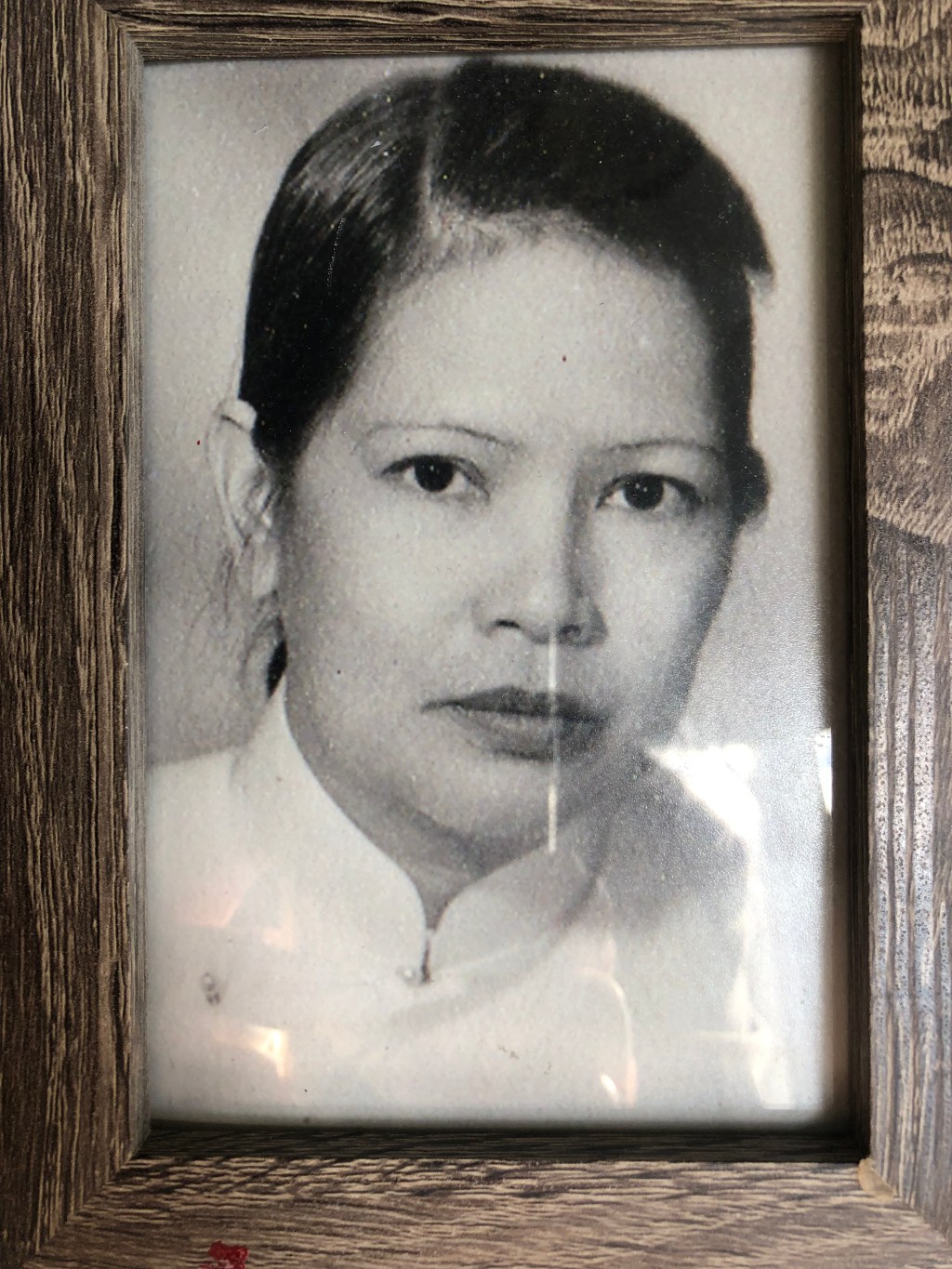
Mom’s Ao Dai

When I saw a Vietnamese woman on motor bike with helmet, mask, sunglasses, messenger pouch, gloves and Ao-Dai steering scooter while holding a baby on her way to the sitter, it brought back memories of Mom’s dress.

She was a school teacher, deeply committed to her multiple roles: mother, teacher, wife, daughter-in-law and friend (to other teachers who had graduated from the same French Lycee, which in her time, was a big brag!).

Having spent her semi-orphan childhood in dormitory, she made sure we have what she had not: a loving home with home-cooked meals.

Not a good cook, she tried most times, without even taking off the Ao Dai she had on from work. By design or default, she had a good assistant: me. Here, hold the live chicken legs while I slit its throat (all the while, she would pray for its soul).

Then she would place the boiled chicken on the altar – an offering to our ancestors on the day leading up to the New Year (Tet).

I learned by observing and via osmosis (run to the market and get me ginger) and by cleaning.

And clean I did, on the cusp of New Year. Mom would put on her Ao Dai right before mid-night, light up three joss sticks and pray to the four corners of the Earth. There was something very sacred at New Year countdown: inspirational enough to my parents who often competed to compose and read aloud a stanza or two to each other (both were well-versed in French …Lamartine, Chopin and Flaubert etc..).

I meanwhile tried to finish up the last rinse for the floor in anticipation of throng of visitors.

Back then, you could hear occasional boom and bang (Chinese enclave was known to spend a fortune on firecrackers e.g. shades of pink and red – color of fortune, evident in spent shells which carpeted their lawn, our version of ticker tape parade).

The whole region threw a big New Year party that makes even the dead want to join.

Years later, Ao Dai evolved in style (Madame Nhu), hence rid of the collar.

But not for my mom.

She stayed on in that teacher’s style all the way to America, where once again, she trekked snowy roads to the Temple on New Year’s Day. I knew then and even now, she had prayed for me, her youngest who has never traveled traditional safe path.

In contrast, the Road Less Traveled took me far from the proverbial tree. The first few feet were the hardest, seeing her wave from my rearview mirror.

This made it hard the whole way to Chicago, to grad school and to an uprooted life.

Her picture has been on my altar. I wonder what gift I should buy to make it worthy a Tet offering (bean bun, bouquet and beer?) Banh chung, bong cuc va bia?

Perhaps the best way to honor and keep her memory is to be the best son/student.

I don’t want to see in the rearview mirror shadow of regrets. I realize the only way she could have let me go was for furthering education. Of any one in my family, she would be the one who understood it best.

When seeing a younger version of herself in scooter, mask, glasses and helmet, but still in Ao Dai, holding a baby on her way to the seaside babysitter, I was reminded of her: sacrificial and selfless, a role model with near spot free existence. Her contribution made my and our human family all the richer.

Si tu n’existais pas, I wouldn’t be here. As keeper of fine and fond memories.

Mom’s Ao Dai.

Flaubert et moi

Actually this is about the redemptive aspect of literature.

Set in 1843, Flaubert‘s character rode the psycho-somatic roller-coaster. The result: Madame Bovary set him apart from his Romantic contemporaries. He started the school of Realism even though he never admitted it. Bovary got married, Bovary got bored, Bovary had an affair and a brush with death but recovered just to fall into the arms of another man.  Finally, bankruptcy and death. But Bovary wasn’t the character. It’s Flaubert’s attempt at depicting French country side and country living of his time (Like Roger Altman‘s films, the place is the main character).

In fact, some critics overheard him said, “Madame Bovary, c’est moi”.

Feeling hemmed in and enveloped by a flat country side which to others  might be heaven – wife of a country doctor  etc…but to our character, it’s an oppression.

She longed for the return of the glamorous “Gastby type”.

Flaubert held up the mirror to show us ourselves, the mirage we invented and dreams projected (which essentially our shadows in the cave).

I had no preconception before reading that piece of art.

Having finished it, I still have no post-conception of it.

It just was. Human nature.

The illusion of a better find around the bend, of Moore’s Law that keeps multiplying to infinity . This is antithetic to Flaubert who was known for his dis-taste of machine.

I wish I could read it in French.

But the English version is Flaubert enough. I understand more about escapism, nihilism and “the journey is a reward” .

The illusion that one can control and change destiny.

As fate would have it, Bovary died a wretched lady and her doctor-husband stayed on in the very town she had detested.

Back then, in that setting, writers must be autocrats to afford deep researching of the characters and setting of a novel.

What would he do had he been born in this century?

Like Norman Mailer, he perhaps would stick with the typewriter and not Twitter.

Meanwhile, what would we do being born in early 1800?

We would die younger, hence the longing for escapism must have come sooner.

Would we want to switch places with them?

Are our qualities of life surpassing theirs?

How about the index of misery?

Perhaps Flaubert breathed cleaner air, but according to his character,

still oppressed and constricted.

The take-away from Madame Bovary is ” le mot juste“. Flaubert would read out loud, finding the right word that tickles the ears.

Again, I wish I could have read it in its original language.

One thing I appreciate about Vietnam: you can go to a bookstore, and buy translated books from Russia, France, America or South America.

Someone, somewhere in this “belong-to-bottom 15” of miserable index, is trying to look up le mot juste, to do justice to an author’s intent.

When they found it, they would not let go of it. So would I. Everything (word) has its place and time under the sun. Flaubert’s place has so far been secured in French literature . If Madame Bovary got digitized though. Flaubert would have hated it.

Maybe all we need is time

Time heals all wounds.

It also ushers in a generation, now in high school and college.

Here in Vietnam, students have classes on Saturdays and even Sundays.

Kids of all ages, in uniforms or out of, but always with a backpack, riding on wheels of all types: bikes, electric bikes, scooters, sedans, and

buses.

They shop at night markets where there are food stalls, snacks stalls and magazine stalls.

Life in the fast lane (the only time I slow down is when I jaywalk across a busy street).

I have tried to put Vietnam in a box, but so far it’s been in vain: not scooter nation, not helmet nation, not multi-tasker nation.

I know one clear difference between life here vs in the US: your survival instinct better kicks in quick (Maslow‘s basic need).

Because it’s noisy, dusty and hot, people want to cocoon themselves in A/C  cul-de-sacs.

Common use of language also helps people cope: “choi” (play aspect) is inserted in every other sentence: “choi troi”, “choi chu”, “choi noi”, “choi luon” (upstage, wordy, flashy and go all the way).

Give Vietnam some time.

It will soon get to be a nation of 100 million, whose population is evenly distributed in a bell shape.

The UN person, Mehta, warned Vietnam about the “middle-income trap”.

They have seen it happen with Malaysia, Indonesia and the Philippines.

The trends are there for Vietnam to grow.  Next step is to harness growth to produce desired outcomes. It’s not accidental that the former leader of Singapore was invited to speak here quite often.

He knew a thing or two about realizing a nation’s dream.

Maybe all we need is time. Some watch trains go by, all of their lives. Watching and wondering how others met and make it last. (courtesy of Stephen Bishop).

Street sweeping in Saigon

I saw a funeral pouring out onto the sidewalk one day, and on the same  block, a wedding the day after.

Meanwhile, the street sweeper just went about his business of sweeping, regardless.

Even if they could use some industrial-grade sweepers, people prefer man to machine. This solves labor problems.

Scavengers make their daily routes by offering to buy anything and everything electronics.

Best Buy could use some help here.

E-waste! What a waste!

As long as one can make a buck, let someone else worry about sustainability.

I love trees but not to the point of being a tree-hugger.

But nothing gives me more pleasure than to see a shaded tree in the middle of a city.

Birds chirping, cyclo drivers napping, and my heart singing.

We got forests and we got trees.

It just that they are “unwelcome” here. Trees take up too much space.

Space for multiple use, such as weddings and funerals, marketing events and Sale Events.

One New Year down, another one (Lunar) to go.

Hoa Mai , kumquat , Lion heads, Earth man, lucky envelopes, confectionary of all kinds.

In the US, they are gearing up for Valentine.

Season changes, but street sweeper goes on sweeping.

Funeral or wedding, summer or fall.

He kept the streets clean, wiping out the past as if nothing had happened.

Bob Dylan’s equivalent , Trinh cong Son, once had a line “the bomb splattered from a distance, and the street sweeper paused to listen”.

If he were to compose a post-war version, it would be “the wedding karaoke party blasted out, and our street sweeper didn’t even stop sweeping”.

Oblivious to noise, dust, and smell, our street sweeper went about his business.

I hope among the stuff that got swept were some dead leaves; it would mean there were still hope of some shades under the scorching sun.

Street sweepers of Saigon keep sweeping and walking man walks on by. That walking man, c’est moi.

Oil-and-water economies

David Brooks of the NYTimes had a piece about the US economy which he coined as “mid-life-crisis economy that needs  to be rejuvenated”.

That’s oil.

Here in Vietnam, I found quite a contrast.

Young demographic, young economy that goes no where but up.

Community Colleges, Trade and Vocational schools, English classes.

One by one, they will progress to the next tier: married, having children, house-hunting and interior furnishing.

The accumulation game: he who dies with the most stuff wins.

People used to be content with three meals a day and a scooter parked in the house.

Then came the phone, the Ipad and the I-pod.

All of a sudden, expectations rise.

A new holiday ring tone, a remote for the scooter alarm, a new app for the I-pad.

Big-box supermarkets are gearing to push consumption pass their “valley of death” (early adopters seem to have done all the shopping they could besides taking trips to Singapore and Australia).

The early and late majority still bond with traditional outdoor venues: bartering is still common, but slowly it is being phased out.

One lighter note during Christmas: the meat-stall ladies up North uploaded their spontaneous dance number onto YouTube.

I can picture them with cell phones urging a quick delivery, but  they are now going “social” and “visual”.

Vietnam got started 40 years ago with Kennedy’s reluctant but pushed-ahead with that fateful decision to engage.

This has set the country back (while Steve  Jobs and Steve Wozniak grew up and toyed with personal computers in their garage).

Now it needs to play catch-up (while taming inflation). A dance that needs skills.

In war, the two sides already seemed to act like oil and water.

Now in peace , the two economies couldn’t be more different: one needs rejuvenation (per Brooks), the other revision.

Random meet

In Vietnam, don’t be surprised when you are placed  next to a complete stranger, who knows someone who knows your host.

It happened to me at Christmas party this year.

Next to me was a Vietnamese-American returning from multiple tours in Iraq.

He was here to fly his wife out. She had flown in as well, but from Australia.

Happy ending: he was back from the war zone while she from a former one.

The company she works for has agreed to transfer her to the US.

I was like NYT‘s Friedman, marvelled at how “flat” our world had become.

A teen-age girl at the table couldn’t help “omg”, “omg” “so you’re like in Hurt Locker?”

We were trying to break the ice waiting to be served when the spot light turned to our returning soldier. Rest of the night was “omg” etc…

I couldn’t help reflect on “the Deer Hunter” syndrome, and how drastic the change had been in our reception of veterans.

This story hasn’t taken into account how high-tech this war was as compared to Vietnam. Incidentally, I read a statistic that mentioned the average life expectancy for Vietnamese: 1960-40 years, 2010 – 73 years.

No wonder it’s jam-packed “scooter nation”.

When my fellow dinner guest left on his perhaps in-law scooter, I said “if you can make it in Iraq, you can ride in Vietnam”.

We were joking about his need to keep in shape after all the good foods.

One common ice-breaking tip is “who would you choose to be dinner guest.”

Some people mentioned Bill Gates, others, Kennedy.

My favorites would be Charlie Rose, since he can draw anyone out of his/her shelf.

Barbara Walters would be interesting if she stopped being a journalist, and just be a conversationalist.

I then would invite Elton John, George Harrison and John Lennon.

Let the party begin.

Random meeting but more enlightened towards the end of the dinner.

I realise one thing after last night: you might not agree with a policy (what Mass Destruction Weapon?) but you need to accept the person, soldier or civilian. We are all floating together (Christ Church in New Zealand got struck twice sitting on the ring of Fire) on the seabed and sitting around the table together.

Disagreement or agreement, we are fellow human beings, seekers of truth and beauty. And perhaps, for a moment there, he and I were both “viet-kieu” (you need a second helping there).

Random meet, but perhaps not quite random after all. Merry Christmas soldier boy!

Long’s last laugh

My friend had a square jaw. When he laughed, his features became more pronounced. Already taller than most, he carried himself above the fold.

Not all kids in my school went to the Conservatory. You had to have talent. For that brief year in 7th grade, he joined us at music practice. “Can you play bass?” I did not know better, nor did I know what would become of us years later.

Long went on to play keyboard for the Crazy Dogs (w/wig and all). Power Trio.

In Senior High, when we each had gone our separate way, I went to the zoo for our version of Woodstock, not knowing he was up there on stage.

I would have been proud. Then years later, in California, we got to meet again, I found Long’s head all shaved (cancer). He had a career in music teaching and performing, most recently at the Hyatt lobby in Ho Chi Minh City.

Top of the line. Last Christmas for Long, as I woke up this morning thinking.

Requiem for a dying friend. Mozart’s style.

Last month, we had a long talk over the  phone before I boarded the plane for Saigon.

Like the story of the Last Leaf (to cheer up a dying man, the boy climbed up the opposite wall to paint a leaf on the tree to give the illusion that only when that last leaf fell that our infirmed person is allowed to die), I challenged Long to see who was going to die first.

That got him a huge laugh over the phone (I used reverse psychology).

Suicidal, like a song goes.

Vietnam‘s favorite English song, according to a study, is “Yesterday”.

In fact, in English class, we used that to illustrate Simple Past.

Yesterday, all my troubles seemed so far away.

Now, kids are into “I am on the Edge of Glory” Gaga, Gaga, Gaga.

Ah Jude, Ah Jude, Ah Jude.

The anthem of youth has always been some refrains such as “Wild Thing, you make my heart sing”, or “We will rock you”.

Something to unite the crowd or to ignite a revolution.

Long taught me one thing: sit back, relax, and let the energy loop from the problem in your hand to your subconscious, then you may find calm in the storm.

Our Western world in crisis can use this very simple advice.

France is now ranked the most pessimistic country as it comes to economic outlooks.

What happened to the innocence of the 60’s, of “Belle de jours”.

Bonjour Tristesse then.

To think of next Christmas when at the mention of my friend, whoever are left in our group will look back in sorrow and sadness.

But from that last conversation with him, I did not feel that way.

He seemed to take it with an air on the G-string.

He even told me “not to eat all that is placed in front of me” when in Vietnam.

I heeded his advice a couple of times when greasy food suddenly appeared in my bowl, at a wedding reception for instance.

I will probably go to the zoo today. The last time I set foot there, Long was on stage without my knowing it. We were rocking, with various bands competing for the same song “Goodbye Yellow Brick Road”.

I hope somewhere in time, I will hear “Goodbye to you my trusted friend, we ‘ve known each other since we were nine or ten”.

I told Long I would be fearless against the wind, when it comes to conspicuous consumption for instance: spending the money one doesn’t have, to buy things one doesn’t need, to impress people one doesn’t like (Black Fridays? Yew! Walmart guard got trampled over in Long Island, or shoppers got pepper-sprayed?).

Even when Long began his quiet withdrawal to a hospice, I know he would pull up a chair, place his fingers on the key board just as I am now, albeit his covers the 7 notes, and mine the Alphabet, then he would inhale and let go.

The loop from fingers to feelings and back. The circle of life, his and ours.

Long’s last Christmas? Yes. But then next year, perhaps yours or mine.

That square jaw of my bass guitarist (sitting down, short sleeves) though seemed so far away, yet as near as Yesterday. I will never forget Long’s last laugh before my long flight East.

P.S. I am very saddened that Long has passed away and will be cremated in New Jersey (I hope his last Tet gave him ample time for closure). R.I.P. Long.

Vietnam got juice

Coconut, sugar cane and other tropical blend to your liking.

http://www.saigon-gpdaily.com.vn/Business/2011/12/99081/

POM(agrenade) has made a blast as new entry into the American juice shelves.

Morgan Spurlock of Super Size Me got around to make a movie about brands.

His VIP sponsor: POM juice.

Branding is both mystical and magical.

It helps institutions and companies thrive and survive the downturn.

When in doubt, keep the cards closer to your chest: TIDE, Coca Cola, British Council.

Honda has suffered some unexplainable scooter explosion lately in Vietnam.

Its nearest competitor, Yamaha, finally gets a leg-up.

(in the US, it’s Hyundai who rules in the wake of Fukushima and Bangkok disaster).

In fact, brand tends to jockey for its nearest one: Vietnam might move up to number 1 rice exporter which has been held by Thai Land.

The Republican presidential candidates know this very well: it’s the poll that takes one up and another poll drags him/her down.

(Two different actresses are jockeying for the role of portraying Sarah Palin; art is more competitive than life).

Vietnam itself can use some brand improvement.

Young and educated work force? Check.

Untapped or not-yet-saturated consumer market? Check.

Strong motivation to leap-frog into software and service? Check.

Second Happiest Country on Earth (Costa Rica being no Uno)? Check.

But then we got traffic congestion in those very same growing centers that are the lures first hand.

Vietnam got lucky by being cautious during the 1997 Asian crisis, and 2007 with the housing-bubble crisis. As my nephew would say, “the poor got their own way of enjoying life”.

First Lady Obama would have a hard time with her childhood obesity campaign here (might have to give KFC’s some head start first). A Wisconsin lawmaker made a remark (then a retract) about her derriere – as a way of saying, what made you qualify to preach. Nobody said anything about Nancy Reagan when she was into “Say No to Drug”, but herself said “Yes to Astrology”.

OK, Vietnam got juice. Vietnam got lucky. Vietnam got work to do to improve its brand (and image). It also has to campaign internally so its sons and daughters will want to come back and work here. All those ambitious, talented folks have fled overseas, a crisis in brain-drain.

Nobody is into patriotism (except when watching a soccer match. Even in the fox hole, one dies for his comrades, not country).

Policy makers will have to help people connect the dots: English-academic success-overseas advanced degree-upward mobility-wealth–recognition among peers – influence which then reinforces life long learning  which leads to a fulfilling life.

Those dots are often not connected or only to a certain point, then leveled off (collectively, it’s called middle-income trap) short-changing the dream.

Both camps (quick money-making trade such as manicure in the US and slow-burned academia pursuit in Liberal Arts) often found themselves at odd with each other. So while Vietnam got juice, Vietnamese run out of them.

When world attention returns to Vietnam, after having focused elsewhere over the past few years, will it find a people who got juice? Or just a place? I hope they will find a country with more smiles and smarts.

Strange sounds, familiar shores

Instead of “I woke up to the sound of music, Mother Mary comes to me…” like Paul McCartney,

I woke up to strange sounds these days: peddlers who use “low tech” au parleur (bull horn) mounted on bicycles or tri-cycles (selling boot-legged CD‘s). In fact, it was my first time got chased by pleasant sound from behind (most of the time, it was emergency vehicle with a sense of urgency). By music here, I mean, not Beatles‘, but Slow Rock (nhac Sen), lamenting heart ache and heart-break.

In the evening, you can hear metal belt sound for in-home massage ( I have never tried).

I miss those wood-on-wood sound of a noodle peddler.

Those were the best snacks a boy could wish for. Speaking of Vietnam childhood and music.

Steve Jobs and friends were listening to music with headsets so they could do it while laying down.

One of his signature photos was an empty room with just a lamp, with him sitting cross-legged.

Very Zen-like. Minimalist. Pure simplicity in design.

He went on to take classes in calligraphy (even Reed College curriculum was still too restrictive for his type).

The sum of all these experience gave us the I-pod with ear-plugs, and later on the I-phone and I-pad.

Studies mentioned that babies could hear before birth.

If this is true, I must have heard an early scooter, a vendor on wheels, someone trying to get the grill going, or a rooster announcing a new day.

Dawn in Vietnam and dusk in the US. (You can experience similar feel, let’s say by traveling down Mexico, but then they got the same time zone as in the US).

Sharing the same Moon.

Sharing the same hope, fear and dream:

Will my kids grow up “con nha lanh” (teachable), and not into drugs.

Will they stay or leave for strange shores?

Will they listen to our voice, those familiar sounds, or they will just “follow the money” and “hearing voices”.

In the end, especially in our flat world, the sound of jet engine and popping soda cans will bring us home from any strange shore.

For a moment there at my friend’s party, we danced and jumped to a familiar tune (sound), felt our hearts go on beating (The End of the World) and saddened “when you say, ‘goodbye'”. The day can’t go wrong when you “get up to the sound of music”, let’s say in “Beautiful Sunday” (when you said, you love me, hey, hey, it’s a beautiful day). Or at night, when soothing sound you first heard while inside Mummy’s womb was that of the noodle man’s peddling.

Old market New market

It’s a norm here in Vietnam that a certain market, after being moved to a new location, still has its old location called “cho Cu” (Old Market). My Dad and I used to go for breakfast in Cho Cu, which no longer does brisk business despite its prime location near the harbor (people are shopping at SuperMarkets, whose plastic baskets are overstuffed with stuff). Now we even have night markets such as Hanh Thong Tay, which during the day, is a “ghost town”.

http://www.eturbonews.com/27000/vietnam-wants-move-away-traditional-markets

Happy New Year, Happy New Year…..

The old markets  offer a common roof, spare ventilation and without piped-in music, whether it’s in the North as in Ham Long, or the South, as in Binh Thoi.

It is said that soothing music induces more shopping. Upscale shoppers want to assert themselves (life-style) and their social status.

In the States, Walmart has crossed-over to Supermarket’s turf (best-selling item: bananas),

Supermarkets crossed over to drug stores’ territories, and Walgreen-CVS crossed over to both.

In the alley outside where I live, people hold make-shift market in the morning: vegetables, fish, pork and fruits. The supply chain is simple: slaughter house to your house, with no refrigerated intermediaries. Chicken got charcoal-grilled inside a bamboo trunk or wrapped inside wet clay, feathers still intact.

It’s a good thing I blog about these things right after lunch (mouth-watering still). Fish glistened under the golden sun, while crabs got lined up in rows and columns neatly like an Excel spreadsheet in a tray outside a restaurant (normally when alive, these legged creatures crawl uncontrollably in all directions). An old American Indian captures this scene: when one tries to crawl out,  the others try to grab it right back in (as in Mission Impossible team rescue to highten the vertigo suspense on top of Dubai’s tallest building).

I had a late lunch next to a table full of restaurant staff. They were getting ready for their busy evening shift, Quang Trung style (celebrating Tet early, to pull off a military campaign that surprised the enemy during the Holidays).

I notice the stark difference in attitude and service between old and new markets: the mom-and-pop folks know your face if not your name.

The Supermarket staff work for a corporation, tend to be younger and can’t wait to get off work (factory style).

College students double up as city workers. College students as bus riders, and consumers of all kinds of goods (sweet and snacks) and services.

College students scramble for exams, for seats on the Last Train Home, for a table outside in the evening.

College students in Old Markets. College students work in New Markets, but can’t afford to shop there.

College students who Google but can’t connect the dots (not yet).  Educational managers whom I visited realize those gaps between High School and College levels, and between academia and active world of work.

(in ICT, this gap is even deeper when work means taking an outsourced load from overseas such as US and UK.  In that space, competitors are India and other Asian Tigers).

Welcome to the new market of talent, place and logistic cross-over (such as Boeing and I-phone, all made from parts supplied elsewhere, and later, sold back to those same countries as complete product.)

Old market, new market. Will one survive in the new century with just a warm smile and a broken back? Happy New Year, Happy New Year. May we all have our hopes, our will to try.

Let’s hope when one chapter is closed, another one will be opened. Places and time, people and opportunities: we are all in transition, from the old to the new.  So is the market. Just make sure you stay alive and hungry! Better that than be “confetti on the floor”.